
Seven free CommonLit reading passages for 3rd and 4th grade, from a ballerina's story to a talking cave, plus what each one teaches best.
When I taught 3rd and 4th grade, I wanted every reading passage my students met to build their literacy skills and to feel relevant and engaging. I bring the same approach to my work at CommonLit, and I'm excited to share seven free passages for 3rd and 4th graders that I'd put in front of my own class.
You'll find informational texts, a poem, and a set of fables and folktales, each with a note on what it's best for teaching. Assign one as a stand-alone lesson, or pair two for a text-to-text comparison.
New to CommonLit? These lessons are free with an educator account. Sign up for one here.
Which nonfiction and poetry passages work for 3rd and 4th grade?
"Dancing Toward Dreams," "Space Food," and "The Impossibles" are three free CommonLit passages for 3rd and 4th grade: two informational texts and one poem. Each is free with an educator account.
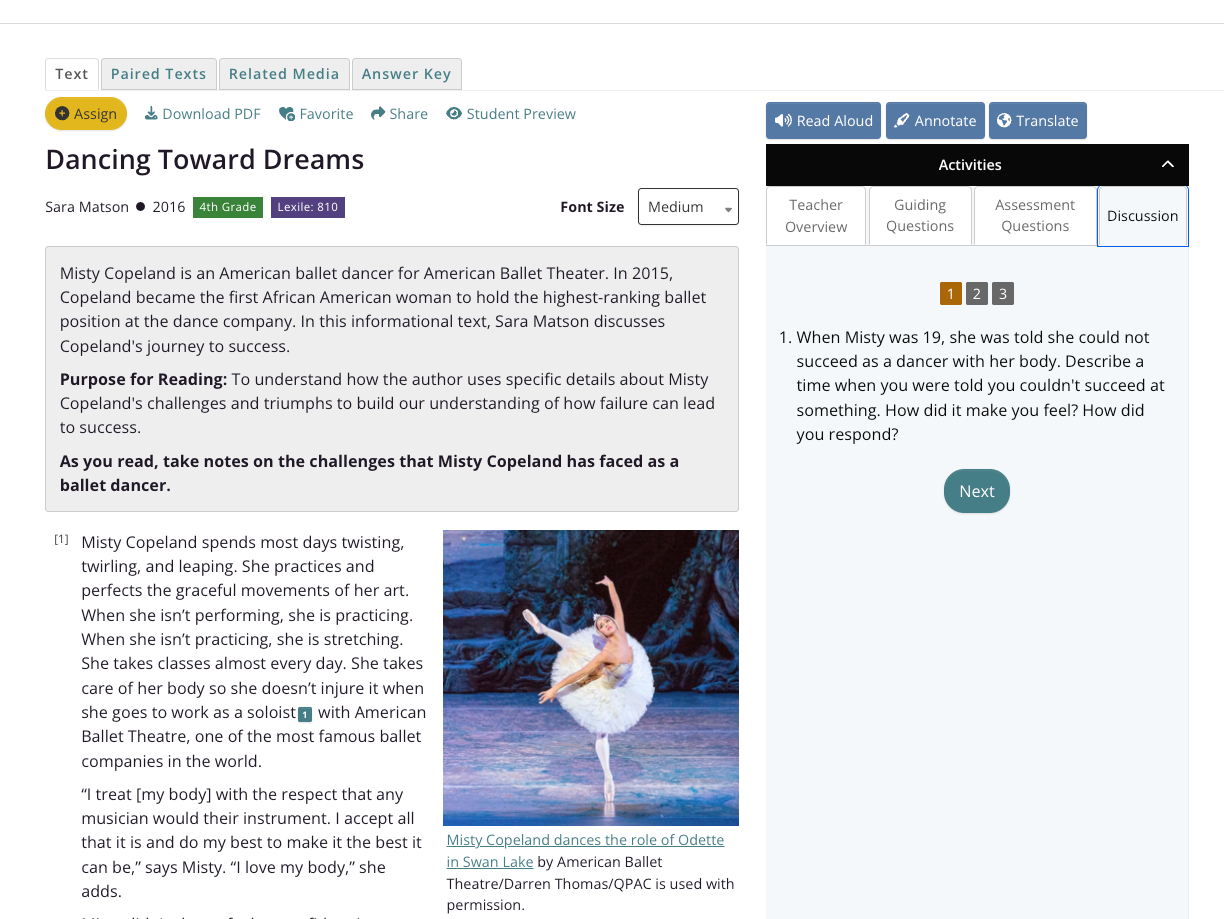
"Dancing Toward Dreams" by Sara Matson (4th Grade)
This informational passage is about Misty Copeland, the first African American prima ballerina at the American Ballet Theatre. It focuses on her achievements and on how she overcame obstacles during her career. It's a great text to assign as part of an African American History Month unit, to start a discussion about how Copeland's resilience helped her overcome challenges. You can also use our Related Media selections to show students a clip of her performance.
"Space Food" by Barbara Radner (3rd Grade)
Students who are fascinated by space and science will love this passage, which is perfect for third graders. It's an informational text about how astronauts eat in space. The text uses a problem-solution structure, so students can examine how information is organized in a nonfiction text while reading about a topic they'll be curious about.
"The Impossibles" by J. Patrick Lewis (4th Grade)
This poem for 4th graders playfully explores the idea of possibility. It's great for introducing imagery and how authors use different images to communicate a message in poetry. If you're already using our Shel Silverstein poetry unit, introduce your students to J. Patrick Lewis and compare how each author uses rhyme and imagery.
Which fables and folktales can I teach in 3rd and 4th grade?
"Kayvan the Brave," "Yeshi's Luck," "The Cave that Talked," and "The Tale of Peter Rabbit" are four free CommonLit passages for 3rd and 4th grade: three folktales and fables from around the world, plus one classic tale. We've built out our collection of fables and folktales because they matter so much in lower elementary classrooms.
"Kayvan the Brave" by Elizabeth Laird (4th Grade)
This passage is an adaptation of an Iranian folktale. A weaver's assistant becomes a celebrated warrior as a result of luck and misunderstandings. After students complete a first read, they can identify the patterns in what happens to Kayvan and discuss how those patterns contribute to the theme.
"Yeshi's Luck" from Naomi C. Rose's collection Tibetan Tales for Little Buddhas (4th Grade)
In this passage for fourth graders, a young boy finds comfort in his father's chant and discovers that things can't be immediately labeled good or bad luck. To encourage text-to-text comparison, read this story after "Kayvan the Brave" so students can discuss how both texts share similar structures.
"The Cave that Talked" by Jyoti Singh Visvanath (3rd Grade)
In this retelling of a fable from India, a clever jackal tricks a lion who is waiting to eat him. This passage for third grade gives students a chance to focus on how a character's actions drive the plot.
"The Tale of Peter Rabbit" by Beatrix Potter (4th Grade)
Students may have enjoyed the Peter Rabbit movie, and after reading Beatrix Potter's story, they'll be ready to compare the film to the original text. This classic fourth grade passage is a good choice for addressing how a character's actions develop the plot. You can also discuss the lesson Peter learns from his adventure into the garden.
Frequently Asked Questions
Are these reading passages free?
Yes. Every text in the CommonLit Text Library is free with an educator account, including reading questions, assessment questions, answer keys, and paired texts. Go to CommonLit.org, click "Sign Up," choose "I Am an Educator," and confirm your school email.
Are these authentic texts I can trust for my elementary classroom?
Yes. An authentic text is writing by a real author rather than a passage written to fit a worksheet. The passages in this list come from authors including Beatrix Potter, J. Patrick Lewis, Barbara Radner, and Sara Matson, and the folktales and fables are retellings by named authors, like Elizabeth Laird's adaptation of an Iranian folktale. CommonLit's curriculum team curates the Text Library and builds each lesson around the text, with reading questions, assessment questions, and an answer key, so the supports are ready when you are. CommonLit is a nonprofit, and the Text Library is free with an educator account.
Can I print these lessons?
Yes. Each text can be downloaded as a PDF or assigned digitally to students.
What grade levels does the CommonLit Text Library cover?
The CommonLit Text Library includes lessons spanning grades 3-12. Once you log in to your free educator account, you can browse the 3rd and 4th grade collection to find more passages like these.
Which of these passages work for text-to-text comparisons?
"Kayvan the Brave" and "Yeshi's Luck" pair well because they share similar structures. "The Impossibles" pairs with CommonLit's Shel Silverstein poetry unit, so students can compare how each poet uses rhyme and imagery. "The Tale of Peter Rabbit" pairs with the Peter Rabbit movie, so students can compare the film to the original text.
Next Steps
All seven texts are ready to assign. Create a free CommonLit account to unlock reading questions, assessment questions, answer keys, and paired texts for every lesson. You can also check out the whole collection of 3rd and 4th grade reading passages in the CommonLit Library.
