Secondary Classrooms Trending 8 New Texts About AI, Social Media, and Algorithms for Secondary Classrooms

Your students already have opinions about this stuff. They know which app is dying, which one their parents don't understand, and exactly how long they spent on their phone yesterday (even if they'd rather not say). What they often don't have is a text worth arguing with.
The CommonLit Text Library just got eight brand new texts that dive into the questions students are already asking outside of class: Is gaming actually an addiction? Should there be an age limit on social media? Can an AI chatbot be a friend?
Each one comes with the full set of CommonLit supports, including guided reading questions, assessment questions, answer keys, and paired texts. Let’s explore these new texts.
"Rumors of Facebook's Death May Be Exaggerated" by Gina Rich (8th Grade)
Facebook is widely written off as a platform for older users, but plenty of Gen Z users keep coming back for one reason: Marketplace. Gina Rich traces how cost savings, sustainability, and entertainment all live in the same app feature. Use it to teach how authors build meaning through intergenerational comparison, or to get students thinking about where their own social media habits intersect with environmental sustainability.
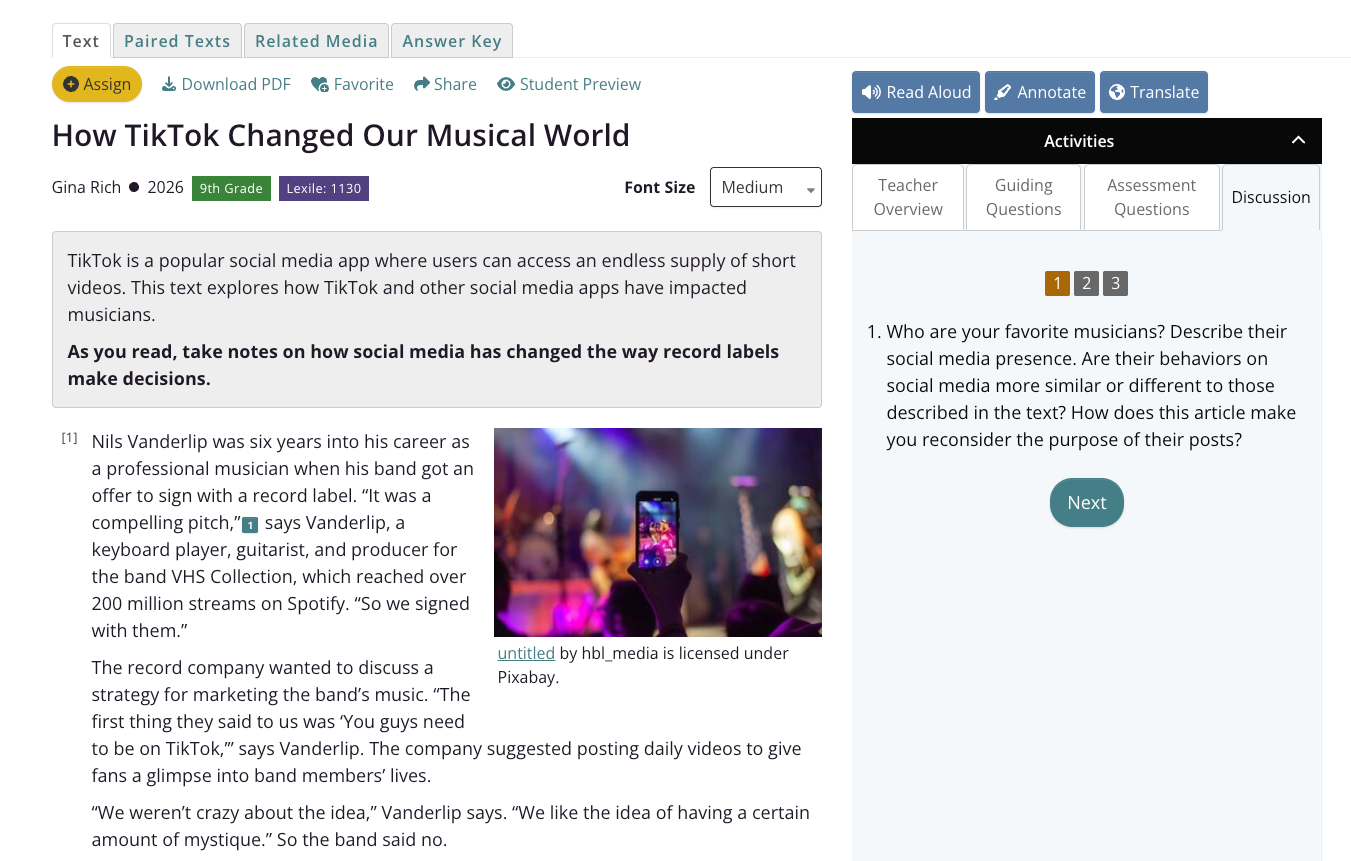
"How TikTok Changed Our Musical World" by Gina Rich (9th Grade)
Record labels used to send employees to rock clubs to find talent. Now they check follower counts. This text follows one band that turned down its label's suggestion to promote on TikTok, then looks at what the shift costs artists in time, mental health, and creative control. This is a strong choice for teaching how an author develops ideas across a text.
"Is Online Gaming Addictive?" by Gina Rich (9th Grade)
After more than a decade of debate, experts still disagree. The text lays out the dopamine and cortisol research behind the case for an official diagnosis, then gives real space to clinicians who think excessive gaming is a symptom of something else and who point to the genuine social benefits of virtual communities. This text is useful for teaching how authors use evidence to support a point of view.
"Could AI Bots Replace Real-Life Friends?" by Gina Rich (9th Grade)
It opens with a girl having a conversation with a friend. The friend is a bot. From there, Rich weighs what a low-risk practice conversation can offer an anxious kid against what a one-sided friendship can't: reciprocity, developmental growth, and the instinct to go to a qualified adult when things get hard. A good fit for teaching central idea development, and for talking honestly about social-emotional development.
"More Teens Ditching Social Media?" by Ruben Brosbe (10th Grade)
Teens average 4.8 hours a day on social media, and most still call it a net positive. This text looks at the ones cutting back anyway, including students forming Luddite clubs and lobbying for new regulations, and closes with practical strategies for reducing usage. The text is great for tracing how an argument develops across varied data sets, and an easy pairing with science content on the developing teenage brain.
"Age Limits on Your Favorite Apps?" by Ruben Brosbe (10th Grade)
We put age limits on tobacco and alcohol. Should social media be next? Brosbe walks through the state and federal legislation already on the table, the mental health and privacy concerns driving it, the First Amendment objections, and the financial reasons platforms are fighting back. This is the perfect text for teaching how authors use data to support claims.
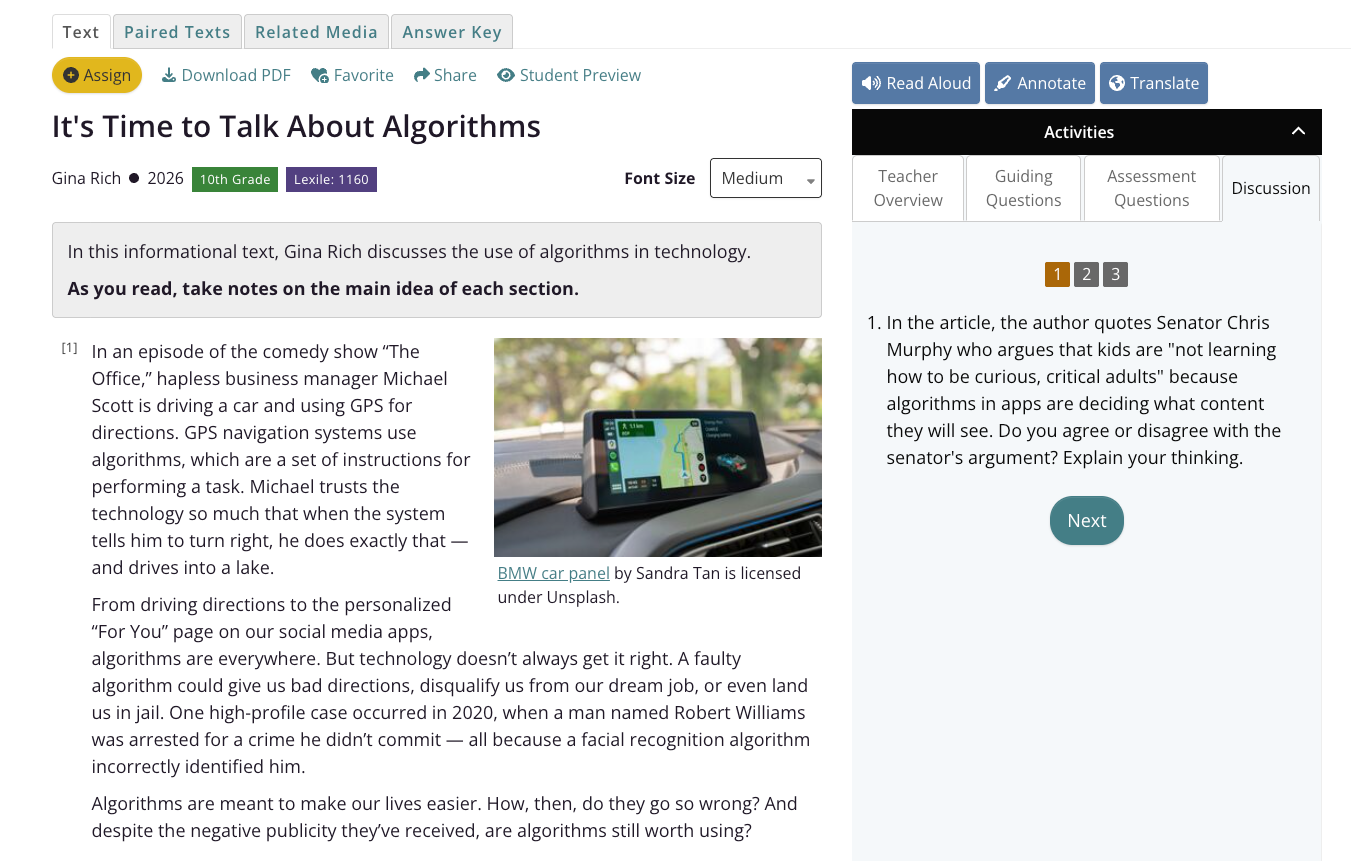
"It's Time to Talk About Algorithms" by Gina Rich (10th Grade)
Algorithms feel objective, which is exactly the problem. This text covers high-profile algorithmic mistakes, shadowbanning, and the ways developer bias and training data shape what students see, without pretending the technology has no upside. This would be a great text for teaching the main idea and supporting detail.
"ChatGPT Resurrected My Dead Father" by Jon Michael Varese (12th Grade)
Varese lost his father suddenly at age nine and found Frankenstein in the middle of his grief. Decades later, he builds a chatbot based on his dad and spends weeks growing attached to it before deciding to wind it down. The result is a personal essay about what AI can approximate and what it can't. This text is excellent for examining how style and content choices deepen meaning in nonfiction, and a compelling addition to a gothic literature unit.
Frequently Asked Questions
Are these texts free?
Yes. Every text in the CommonLit library is free with an educator account, including reading questions, assessment questions, answer keys, and paired texts. Just go to CommonLit.org, click "Sign Up," choose "I Am an Educator," and confirm your school email.
Can I print these lessons?
Yes. Each text can be downloaded as a PDF or assigned digitally to students.
What grade levels are available?
This collection covers 8th, 9th, 10th, and 12th grade, with Lexile levels listed on each text page. However, The CommonLit Text Library includes lessons spanning grades 3-12.
Next Steps
All eight texts are ready to assign. Create a free CommonLit account to unlock the full library, including guiding questions, assessment questions, answer keys, and paired texts for every lesson.
