CommonLit 360 Foundations: Building Collaboration Through Reading Modalities and During Reading Questions


Here at CommonLit, we have four Guiding Principles that represent our foundational beliefs about teaching and learning. Our curriculum team—all experienced former educators—have carefully developed CommonLit 360 to align with these guiding principles and ensure that each unit and lesson is designed to support the growth and success of all learners.
In this blog series, we have invited members of CommonLit’s curriculum team to share a bit more about the practices that support the design of our curriculum. This article is connected to Guiding Principle 4: Learning is Fundamentally Social. We believe that learning is an inherently social process where students acquire knowledge and skills through interaction, collaboration and observation. Learn more about our Guiding Principles in our CommonLit 360 Program Guide!
Why Social Learning Drives Our Design
At CommonLit, Guiding Principle 4 is simple and powerful: learning is fundamentally social. Students don’t grow in isolation; they learn through interaction, collaboration, and observation. That belief sits at the heart of how we design our reading lessons. To unpack the “why” behind our choices, I spoke with curriculum writer Leah Tribbett, a former middle school ELA and social studies teacher who has helped craft multiple CommonLit 360 units.
Busting a Myth: Digital ≠ Silent
A common misconception is that “digital” means “silent.” In reality, our lessons build talk into the routine. “The social aspect is incredibly important, particularly for Multilingual Learners,” Leah explains. Each reading lesson includes structured opportunities for students to discuss texts and ideas with peers. You’ll see this in turn-and-talks, quick think and share questions, partner reading and discussion questions. Conversation isn’t extra - it drives comprehension and engagement, and it’s baked into the design.
CommonLit 360 Reading Lessons Increase Engagement through Reading Modalities
CommonLit 360 reading lessons integrate three different types of reading modalities, or ways that students interact with the text: Whole Class Reading, Partner Reading, and Independent Reading. As students move through a text through those different modalities, they encounter embedded, text-dependent questions that encourage collaboration and authentic skill practice.
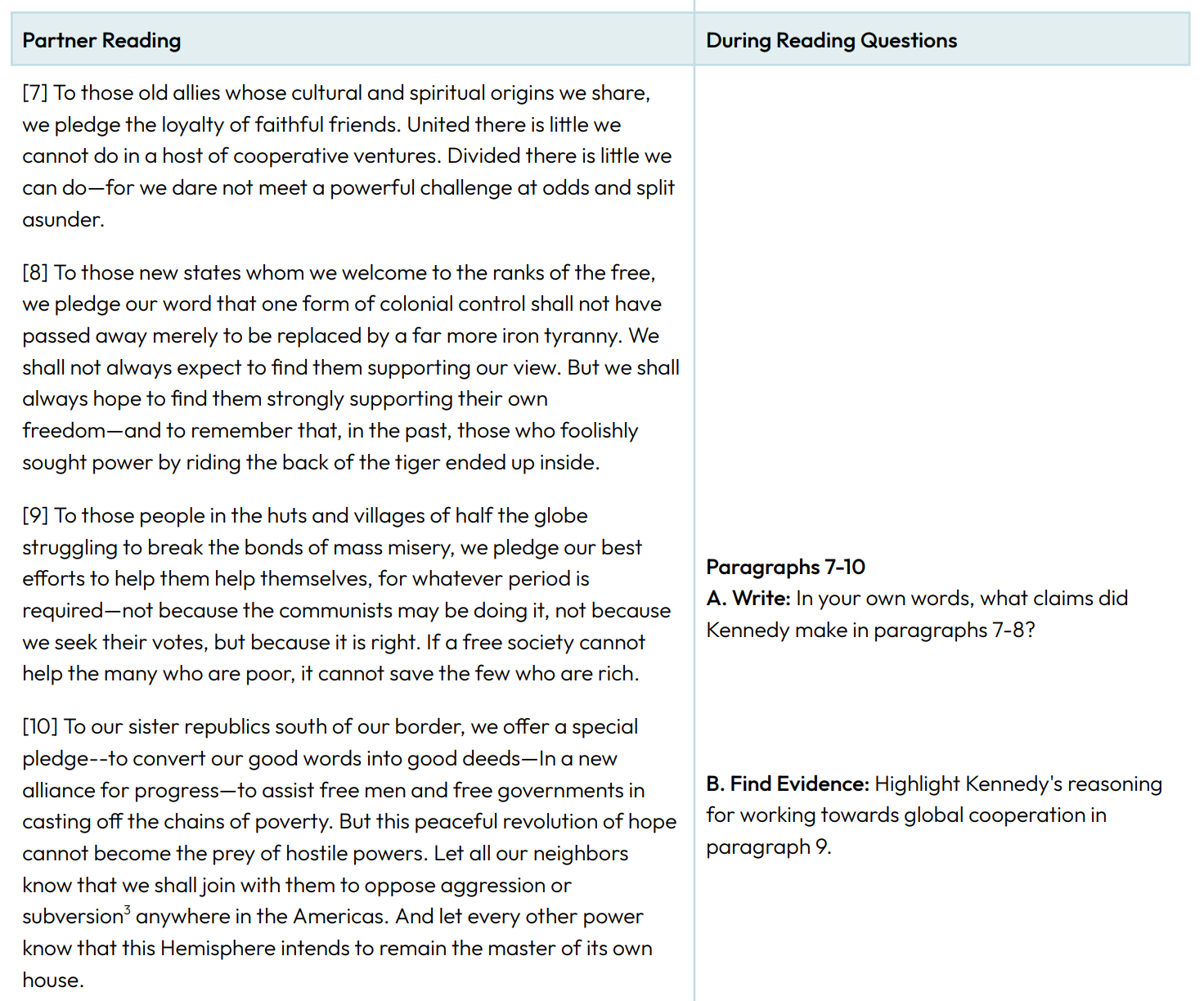
Reading Lesson Student Copy from 9th Grade Unit 1
Choosing the Right Modality: Text, Skill, and Engagement
In each unit, writers plan the Arc of Reading Instruction with gradual release in mind. As texts grow more complex, students’ skills and independence do too. “We track modalities for every lesson,” Leah says. “We often begin with Whole Class or Partner Reading and move toward independent annotation, especially in high school.”
Curriculum writers are incredibly intentional when crafting a reading lesson and deciding when to include a particular reading modality. Modality choices depend on text complexity, the skill focus, and student engagement.
Whole Class Reading: Community and Modeling
Whole Class Reading builds community and gives teachers a chance to model thinking moves in real time. Leah laughs when she says that, “vibes‑wise,” it’s underrated. Those intentional whole class moments - during a big reveal in a short story or launching into a tricky text as a whole class with the teacher confidently setting the tone - are the moments that build community and engagement. But the instructional payoff is also practical: students get to hear expressive, fluent reading modeled naturally by a teacher, and they learn to monitor their own comprehension by listening to peers’ questions and reactions.
Curriculum writers are intentional about when to include Whole Class Reading in a text. While many lessons often start with Whole Class Reading to set the tone, some lessons also pivot between modalities. Curriculum writers will often select key moments in a text to bring students back together for Whole Class Reading after Partner or Independent Reading; for example, In 9th Grade Unit 1, the ending of “The Lottery” is designed as Whole Class Reading so the class has an opportunity to share the experience of the short story’s shocking revelation.
Whole Class Reading also offers an opportunity to provide key scaffolding with particularly challenging vocabulary or text structure; for example, 10th Grade Unit 4 Ed2.0 Voting Rights: Then and Now contains speeches that are high in complexity, like Dr. Martin Luther King's “Give Us the Ballot” and Lyndon B. Johnson's “We Shall Overcome.” For these lessons, we begin with Whole Class reading and During Reading questions to establish key skill and knowledge building, and then gradually release students to more independence as the text moves on.
Partner Reading: The Bridge to Independence
Partner Reading is the bridge between the collective experience of Whole Class Reading and individual ownership that students must use in Independent Reading. Partner Reading is social and supportive for students and incredibly informative for teachers. As you circulate, you can hear how students are interpreting a claim, which words are confusing, and where student responses are going off the rails. That real‑time insight lets you decide whether to coach a pair on the spot or briefly pull the class back together for a quick reset. For students, the stakes feel manageable. “Partner reading is low risk, high reward,” Leah says. “It’s the practice-time before you get to game day, which is the Independent Practice.”
The first few tries with Partner Reading may be messy, and that’s okay. Students often need explicit routines to support an effective use of Partner Reading: who reads first, how far to read, when to pause and switch, how to share responsibility for questions. With a few repetitions, the routine becomes second nature and the quality of talk will improve.
Independent Reading: Confidence and Ownership
Eventually, the training wheels come off. Independent Reading gives students time to apply strategies at their own pace - rereading a paragraph, skimming ahead to orient, then going back to annotate with purpose.
Curriculum writers are also strategic about when to include Independent Reading within a lesson. For example, they may decide a chunk of text is best for Independent Practice if it is especially accessible, or if students have had at-bats with the genre or skill focus earlier in the unit or year and are ready for the challenge.
The goal is confidence and clarity, not surprise. “We don’t want ‘gotcha moments’ in reading lessons,” Leah explains. “We want students to hit the Independent Practice and think, I’ve got this.” That message matters. Our reading lessons are intentionally rigorous because we believe students can do them. Independent Reading moments within lessons communicate that trust to students while reinforcing the toolbox they’ve been building alongside their classmates. If we skip opportunities for Partner Reading or Independent Reading, we risk sending the message to students that we don’t think they can handle it, a message that they may eventually internalize.
Backward Planning: Questions That Prime Students for Success
Our reading lessons are backward‑planned. Curriculum writers write the Independent Practice questions and the exemplar student responses first, then craft During Reading Questions or annotation tasks that point students toward the kind of thinking that the Independent Practice requires. Sometimes the alignment is direct: if the Independent Practice asks about tone, students will practice identifying tone and the words that create it. Other times it’s more global: a lesson may emphasize structure, evidence, or foreshadowing because those elements are essential to understanding the text on its own terms.
The modality influences the “feel” of questions too: whole‑class moments invite quick Think & Share questions when a single, short answer is expected, or a Turn & Talk when students are reading in partners and need to discuss a complex or engaging idea with a peer. Annotation tasks can live in Whole Class or Partner Reading, with brief pauses for students to compare notes and decide what’s worth writing down. Independent Reading tends to include more opportunities for written reflections, so students' responses or annotations leave a visible record that sets them up for success on the Independent Practice.
The Payoff for Students and Teachers
The payoff for following the Reading Modalities and leveraging those intentional opportunities for social learning is significant for students and teachers alike. Students gain fluency, vocabulary, and the discussion skills that help them ask for help and help a peer; they also become more confident tackling complex texts and articulating their thinking. Teachers get smoother routines, clearer windows into student understanding, and more time to confer while the room hums with productive, on‑task talk. “In the long run, classrooms run more smoothly,” Leah reflects. “Teachers have the mental capacity and literal time to walk around and check in individually with kids.”
Final Encouragement
Leah’s closing advice is the one I’ll leave you with: trust the design. It’s research‑aligned, classroom‑tested, and intentionally flexible so you can make it your own. Start where you are, keep talk purposeful, and release the responsibility over to students at the suggested moments during Partner Reading and Independent Reading. “Give it a try,” Leah says. “It makes classroom communities much stronger because students know you trust them.” When students know they’re trusted and have regular chances to talk, test, and revise their ideas, they don’t just learn the text in front of them. They learn how to learn with others.
Curious to learn more? Explore CommonLit 360 or reach out to our team – we’d love to show you how this social approach to learning can transform your classrooms.
