Free vs. Paid Reading Assessments for Grades 3-12: CommonLit's Free Test and Assessment Series Compared

A side-by-side look at CommonLit's one-time Free Reading Assessment and the three-test Assessment Series (included in Spark, Core, and Elevate), including what each includes and the data you'll get.
It's the second week of school and you've got 26 new names on your roster. Not to mention, the two other students who might swap in from the class across the hall. You already know who talks the most and who is new to the school. You don't know how your students' reading comprehension stacks up to grade level expectations.
A baseline reading assessment closes that gap fast. CommonLit offers two options: the Free Reading Assessment, which any teacher can schedule today, and the Assessment Series, a set of three benchmark tests schools use to track growth from fall to spring that begins with a Pre-Assessment.
Here's what each one includes, what data you'll see, and how to decide which fits your classroom or school.
New to CommonLit? The Free Reading Assessment is free with an educator account. Sign up for one here.
What is CommonLit's Free Reading Assessment?
CommonLit's Free Reading Assessment is a one-time reading comprehension test for grades 3-12 that any teacher can assign at no cost. Each grade-level test has three passages (typically two informational and one literary) and 21 to 38 multiple-choice questions.
You schedule it from your CommonLit account, and students take it online. It isn't timed, though most students finish in 50 to 60 minutes. Every question is graded automatically.
What data do teachers get from the Free Reading Assessment?
The Free Reading Assessment reports three numbers for every student: overall percent correct, percent correct by standard category, and a percentile ranking that compares the student with other CommonLit students who took the same grade-level test. Students are also sorted into performance groups based on those percentile rankings.
That's enough to see where your class starts and how students performed relative to others who took the same test. It's a single snapshot, though. The Free Reading Assessment doesn't produce scaled scores, so it can't measure growth over time.

What is the CommonLit Assessment Series?
The CommonLit Assessment Series is a set of three benchmark reading assessments for grades 3-12, given at the beginning, middle, and end of the school year. It's built for schools and districts that want to measure growth, not just a starting point.
- Pre-Assessment: Collects baseline data in the fall.
- Mid-Year Assessment: Measures growth, so you can consider how to adjust your instruction for the rest of the year.
- Post-Assessment: Measures growth across the full year.
Each test includes three passages (two informational, one literary) and 28 to 38 multiple-choice questions. Unlike the free test, the Assessment Series has been field-tested and has psychometric reliability and validity evidence behind it.
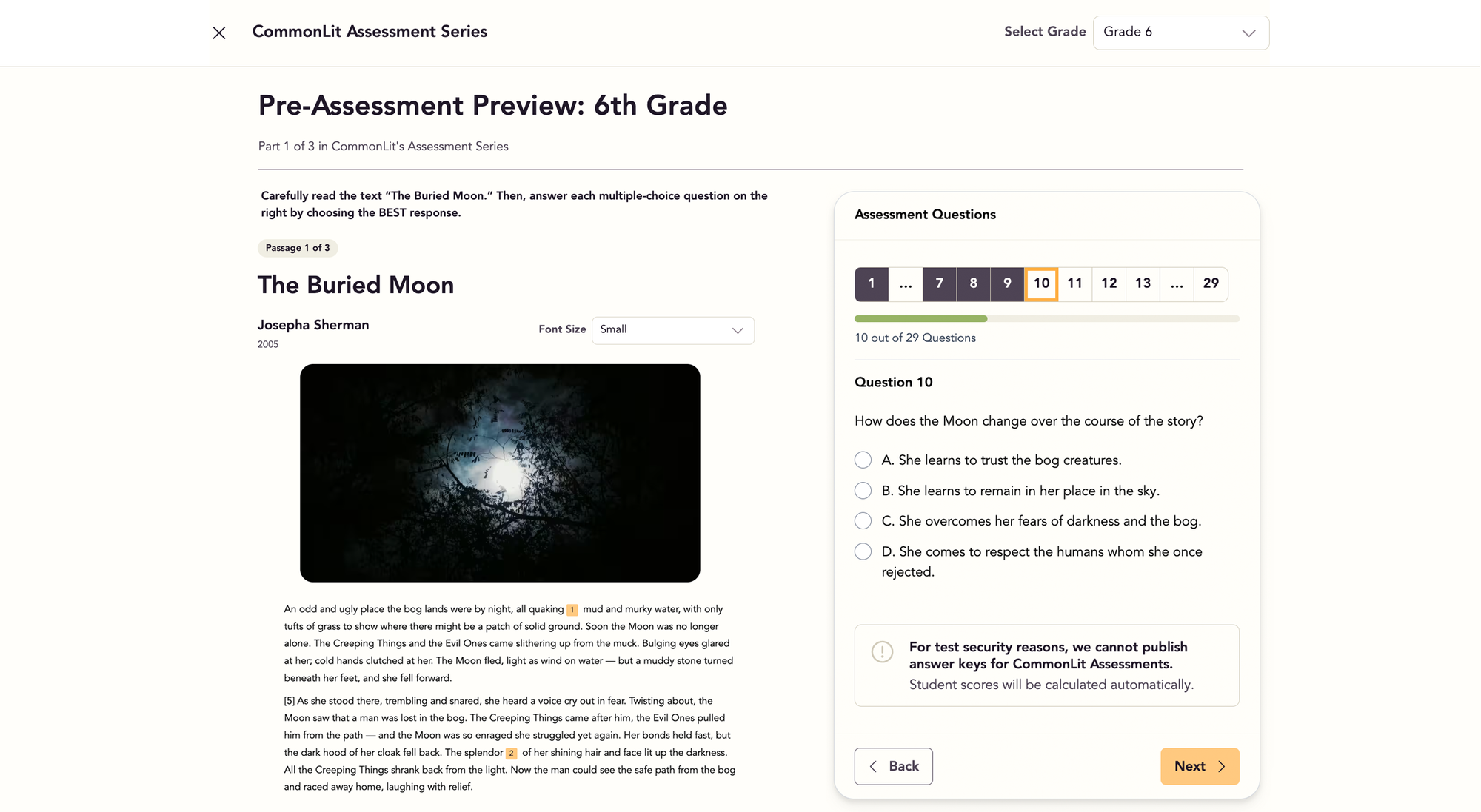
What is a scaled score on the CommonLit Assessment Series?
A scaled score is a number from 150 to 250 that reflects both how many questions a student answered correctly and how difficult those questions were. Higher scores mean stronger reading comprehension.
Because difficulty is built in, a scaled score on the Mid-Year Assessment means the same thing as a scaled score on the Post-Assessment, even if one test runs slightly harder. That's what makes growth measurement possible. It's also why two students with the same percent correct can end up with different scaled scores.
What do the Assessment Series performance groups mean?
Every student lands in one of three performance groups based on their scaled score: Below or Approaching Grade Level, On Grade Level, or Above Grade Level. In every grade, a scaled score of 205 places a student On Grade Level, and 220 places them Above Grade Level.
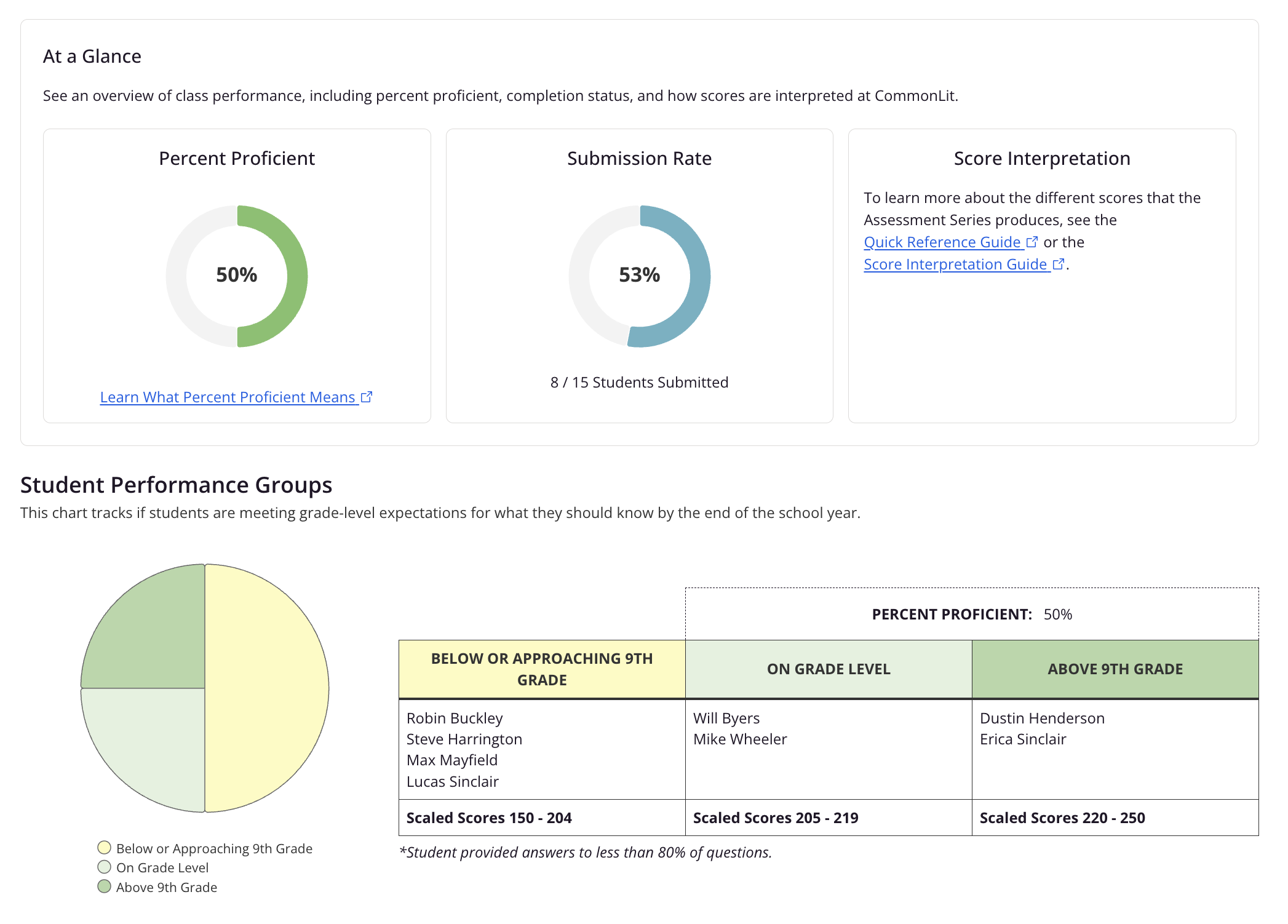
The groups are tied to end-of-year expectations, so don't panic if many students fall below 205 on the Pre-Assessment. That's a normal fall starting point. The cutoffs were set by panels of teachers in each grade, who defined what students at each level should be able to do.
How does the Assessment Series show student growth?
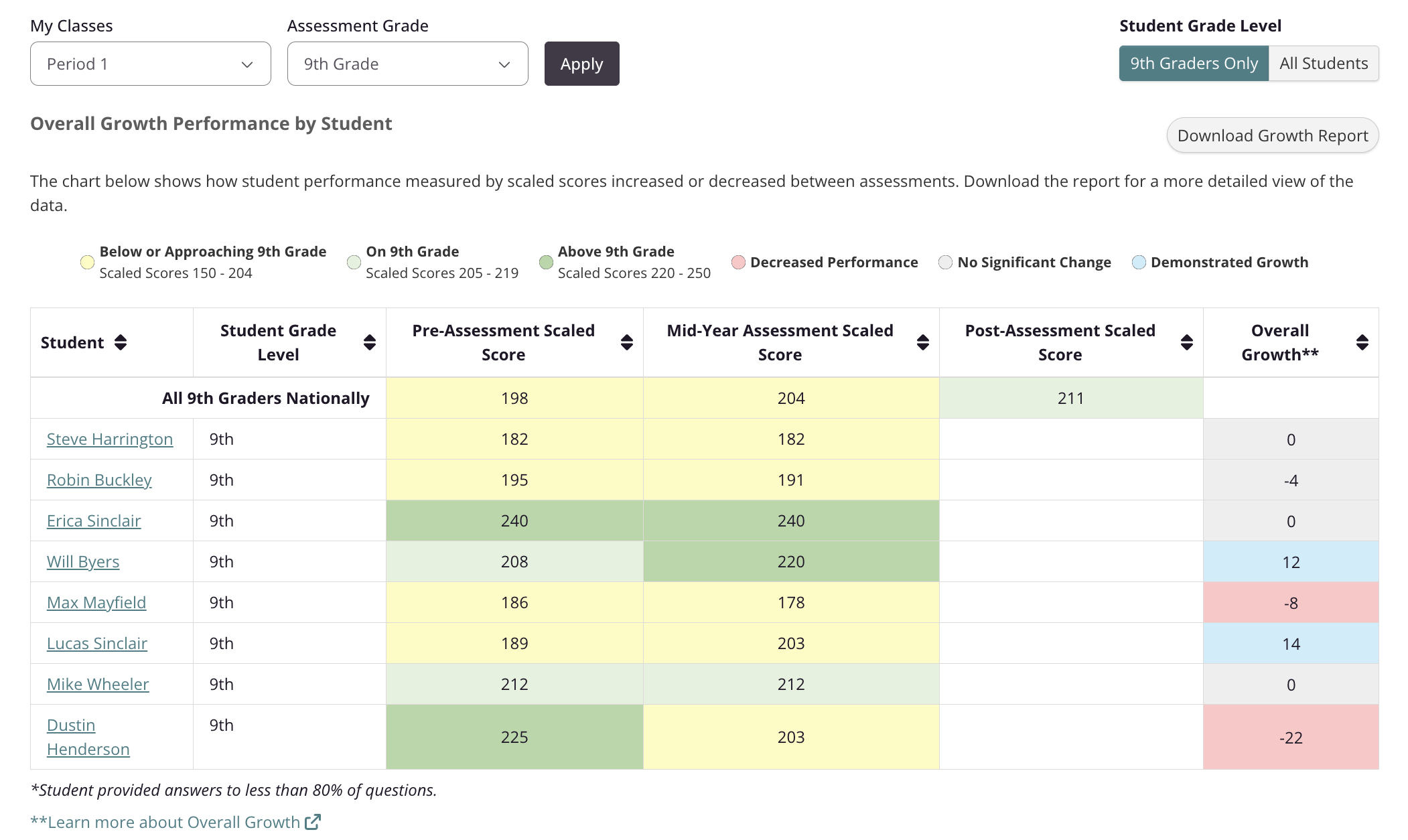
The Assessment Series calculates each student's Overall Growth as the difference between their scaled scores on the earliest and latest tests they've taken. If a student took all three, it's their Post-Assessment score minus their Pre-Assessment score.
Not every change counts. Scores shift a little from test to test because of focus, motivation, or a noisy testing day, so growth reports mark a "No Significant Change" range for each grade. Only growth beyond that range is flagged as Demonstrated Growth.
For context, average growth from the Pre-Assessment to the Post-Assessment in the 2025-2026 school year was eight scaled score points in grades 3-5, five points in grades 6-8, and six points in grades 9-12. Treat those as reference points, not targets. Students who start Below or Approaching Grade Level often have more room to grow than students who start Above.
How should teachers use standards-level data?
Use standards-level data to guide broad instructional moves, not to label students as proficient on a single standard. Each standard appears only a few times per test, and percent correct by standard doesn't account for question difficulty.
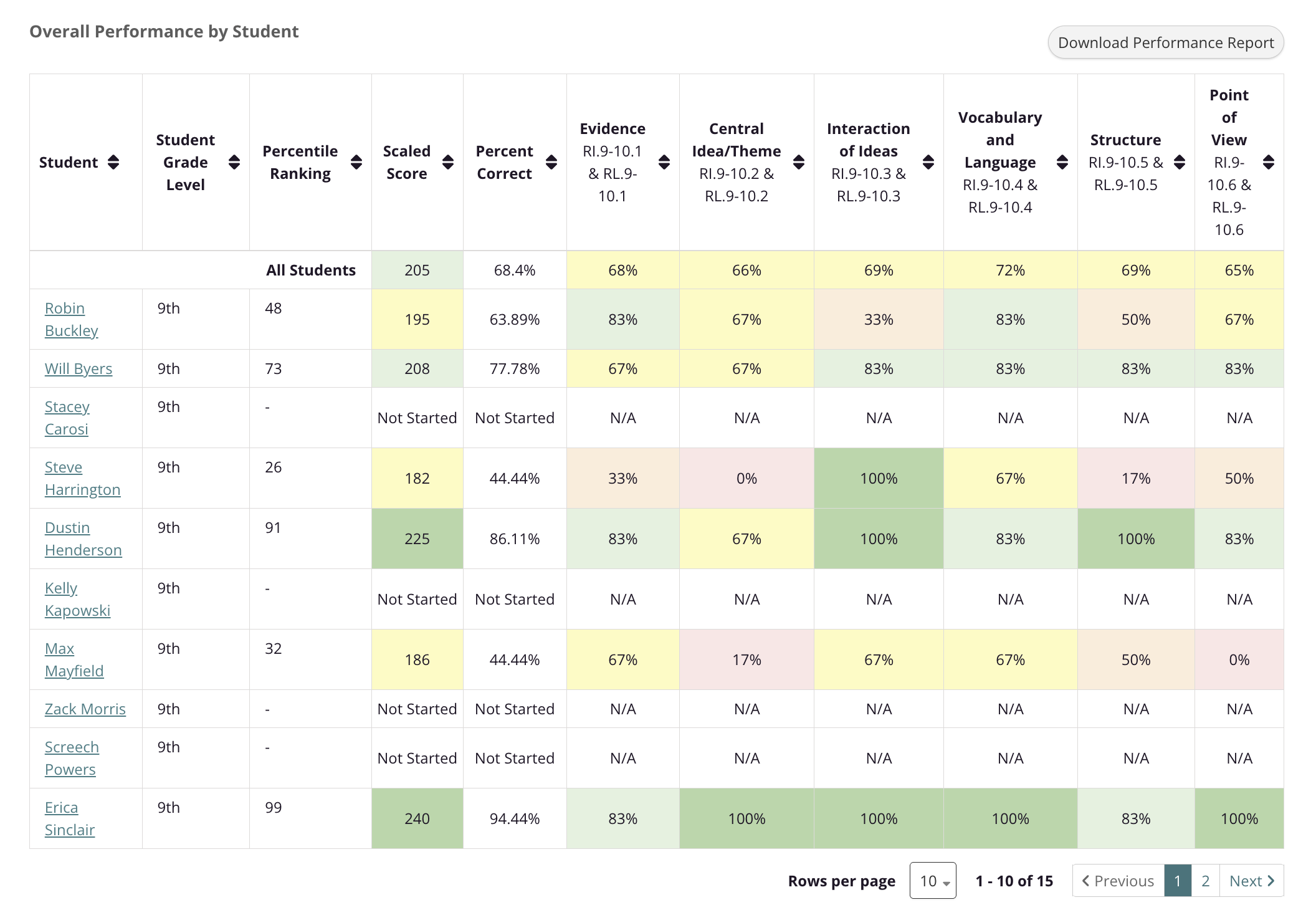
Scaled scores, performance groups, and growth scores are the most reliable numbers on the report. Start there, then treat standards data as one clue among many. Low scores in the R.4 category, alongside what you're seeing in class, might be your cue to pre-teach key academic vocabulary before students read an informational text.
What data do administrators see?
Administrators get school- and district-wide reports through a dedicated data portal, including percent proficient: the share of students scoring On or Above Grade Level in a class, school, or district. Those reports show which grades and classrooms are moving and which students may need more support before the Post-Assessment.
Cutoff scores now stay the same across grades and from year to year, so leaders can compare performance over time without recalculating what "on grade level" means.
How can my school or district get the Assessment Series?
Schools unlock the Assessment Series by purchasing CommonLit Spark. Administrators at schools with CommonLit Spark, Core, or Elevate also receive school- and district-wide data reports.
Once your school becomes a partner, CommonLit's team turns on all three assessments. Teachers assign and schedule them through CommonLit.org, and will have access to professional learning modules to support them with test administration and score interpretation.
Frequently Asked Questions
Is CommonLit's reading assessment free?
Yes. The Free Reading Assessment is free for individual teachers with a CommonLit educator account. The three-test Assessment Series is available to schools and districts with a paid CommonLit package.
What grades does the CommonLit reading assessment cover?
Both the Free Reading Assessment and the Assessment Series cover grades 3-12.
How long does the CommonLit reading assessment take?
Most students finish in 50 to 60 minutes. The tests aren't timed, and teachers can lock a test so students can't work on it outside of class.
Can I compare Free Reading Assessment scores with Assessment Series scores?
No. The two tests are scored differently. The Free Reading Assessment reports percent correct and percentile rankings, while the Assessment Series uses scaled scores, so results from one shouldn't be compared with the other.
Can I use Assessment Series scores in class grades?
No, we don't recommend it. Assessment Series scores aren't designed for course grades. They measure reading comprehension against end-of-year expectations and work best alongside other information about your students.
Next Steps
For teachers: The Free Reading Assessment is ready to schedule. Create a free CommonLit account to get baseline data on your students before your next unit.
Create a free account here.
For administrators: Want to measure reading growth across your school or district? Get a quote for our Spark package ($4,200 per school for SY27-28) or connect with the CommonLit team to discuss all of our partnership options.
