CommonLit Usage Positively Related to Students’ Scores on the Maryland Comprehensive Assessment Program (MCAP)


At a district in Maryland, students who completed more digital CommonLit lessons than their classmates scored modestly higher on the state ELA test.
A district in Maryland partnered with CommonLit to learn more about the relationship between CommonLit usage and students’ performance on the state ELA test. Across several statistical models, results showed a positive relationship between CommonLit usage and MCAP performance. This study was reviewed by Instructure’s Research team, an external research group, and validated as meeting ESSA Level 3 (“Promising Evidence”) standards.
About the Sample
This study examined students who took the Maryland Comprehensive Assessment Program (MCAP) ELA test in the 2024-2025 and 2025-2026 school years and submitted at least one digital CommonLit lesson in the 2025-2026 school year. The sample included 9,153 students in Grades 4-8 taught by 240 teachers in 43 schools in a district in Maryland. Based on National Center for Education Statistics (NCES) data, 13 schools (30%) were eligible for Title I funding. Student-level demographics were provided by the district. The analysis sample included 51% male students and 49% female students. In terms of race and ethnicity, the sample included 63% White students, 16% Black students, 10% multiracial students, 7% Hispanic/Latino students, and 4% Asian students. Three percent of the sample qualified for English Language support. Fourteen percent of the sample received special education services. Thirteen percent of the sample were identified as gifted and talented.
Key Finding: Students Who Submitted More Lessons Than Their Classmates Scored Modestly Higher
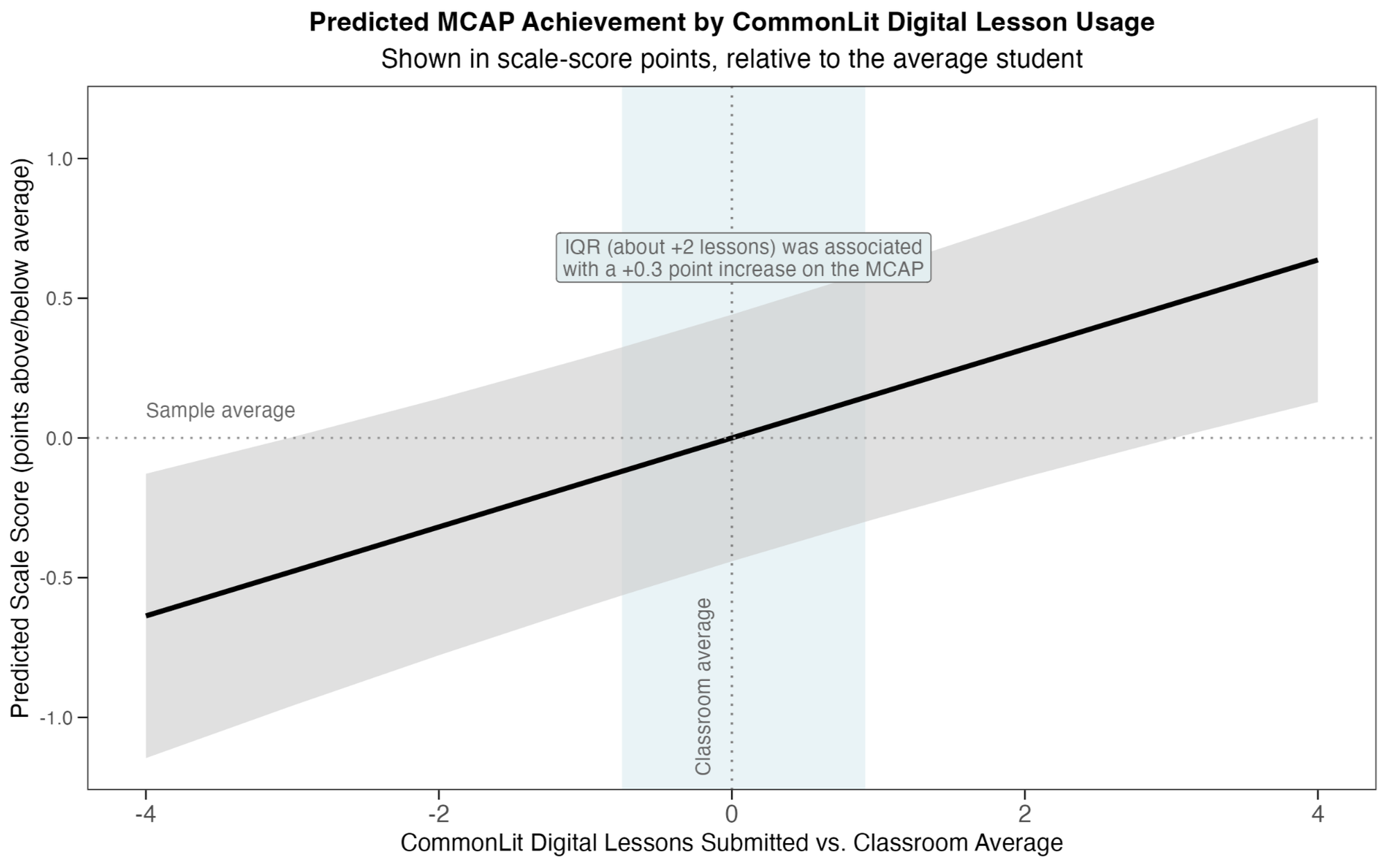
Students who submitted more digital lessons than their classmates tended to have higher MCAP ELA scores, even after accounting for MCAP scores from the prior year, grade, student demographics, and Title I eligibility. The difference was modest, translating to 1 point higher on the MCAP for a student who completed 6 more lessons than their classmate with similar baseline scores (see Figure 1).
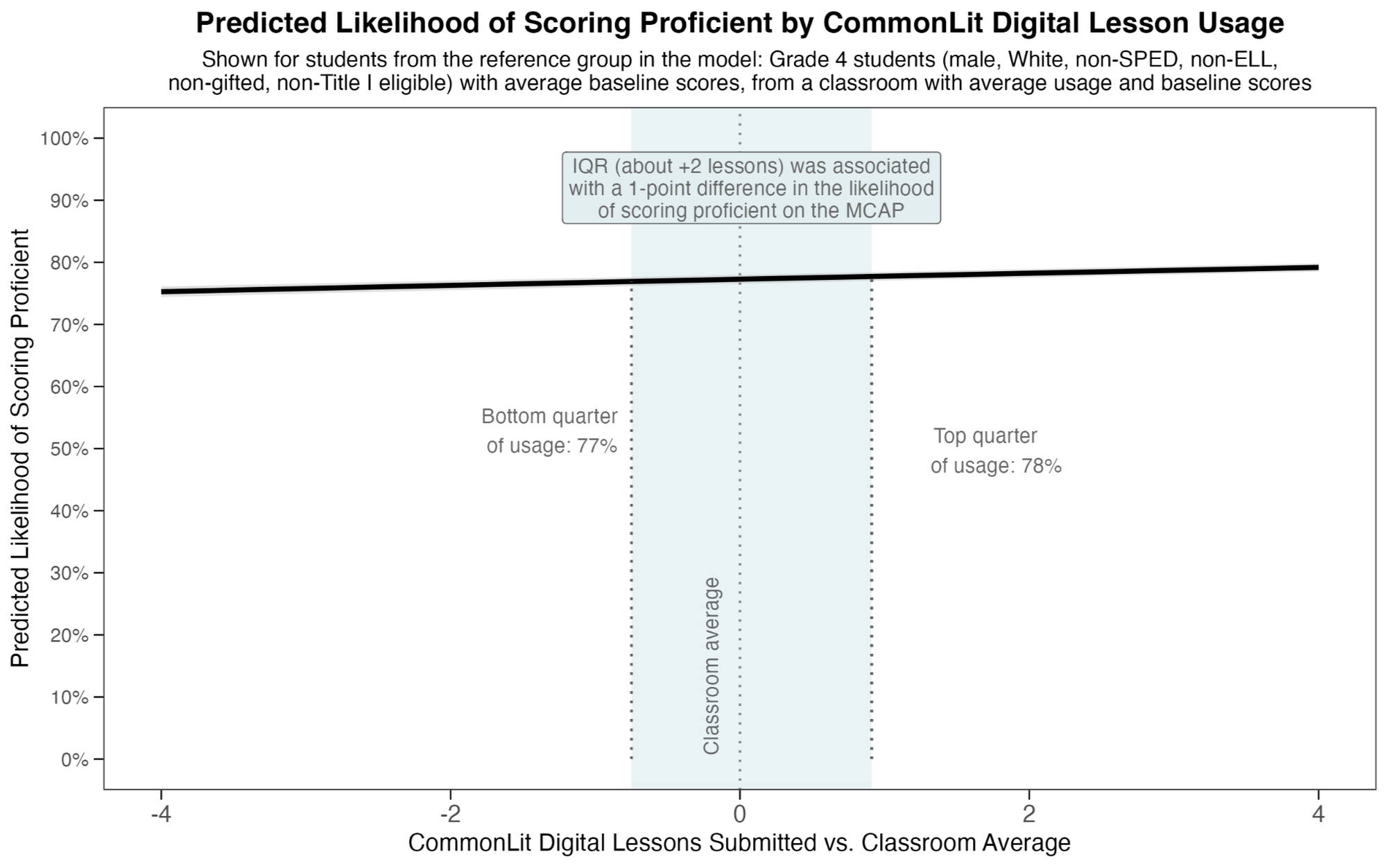
Students who submitted more digital lessons than their classmates were also more likely to score at the proficient levels (Levels 3 and 4) on the MCAP (from 77% to 78%; see Figure 2).
These results were robust to several checks, such as excluding very small classrooms, students with the most usage, and classrooms with an outsized influence on the results. Results also held across student demographic groups. In sum, this study demonstrated a positive relationship between CommonLit usage and student achievement on the MCAP. For more information about the study, see the technical report.
CommonLit is evidence-based
Studies like this one add to CommonLit’s growing evidence base. To ensure that CommonLit’s programs are aligned with the mission to close the literacy achievement gap, both external evaluators and researchers on CommonLit’s evaluation team are constantly monitoring student outcomes. CommonLit’s evidence-based approach directly supports districts by giving them confidence in our programs through Every Student Succeeds Act (ESSA)-rated studies.
About CommonLit
CommonLit offers several educational resources for teachers and schools. CommonLit 360 is CommonLit’s free English Language Arts program that includes a year-long curriculum, assessments, professional development, and data dashboards. EdReports rated CommonLit 360 as all-green for Grades 6-8, or “meets expectations,” as a quality curriculum. CommonLit also offers a Text Library that includes a wide variety of standards-aligned texts as well as supplemental lessons and Target Lessons designed to support the learning needs of all students. To address inequities in access to technology in classrooms, CommonLit materials are available to teachers and students both online on the digital platform and offline as downloads.
Get These Results in Your District
Want to see these results in action? Connect with our team to learn how CommonLit 360 can support your school.
