Build student reading comprehension with highly engaging novel study units, complete with lessons, chapter guides, and everything teachers need, all as part of CommonLit 360.
There's something that happens in a classroom when students are reading the same book together: a shared experience that opens up real conversation, debate, and connection. But making that happen takes more than assigning a novel. It takes intentional planning, the right materials, and a clear sense of where you're headed.
CommonLit 360 novel units are designed to do exactly that, giving you everything you need to bring the novel to life and to make sure students are building skills and knowledge along the way.
Why Novel Units Matter for Students
Reading novels benefits students beyond the story itself. Full-length texts help students build the complex analytical skills that come from reading and thinking deeply about an author's message and purpose. They also give students the opportunity to make text-to-self, text-to-text, and text-to-world connections. And when students share a novel together, it builds classroom community through discussion and shared experience.
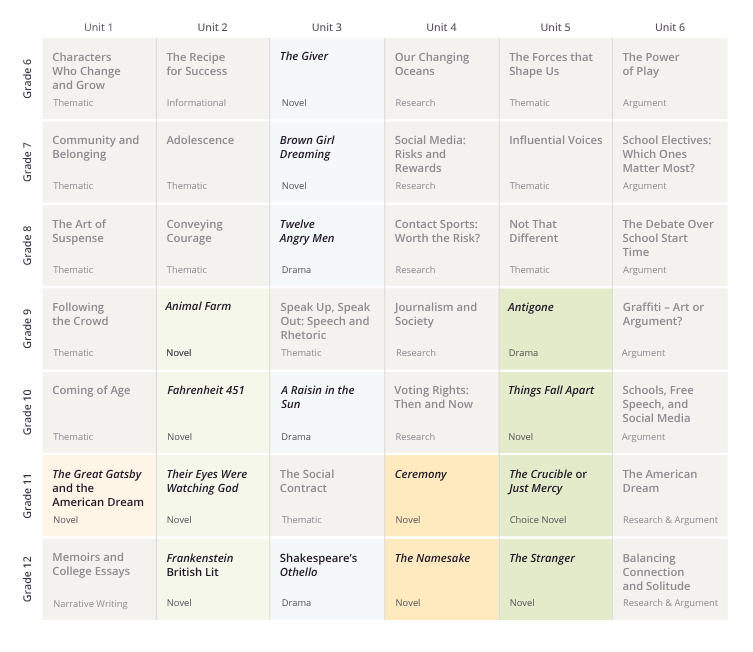
CommonLit 360 novel units span grades 6-12 and include high-interest, grade-appropriate texts. From classics like Animal Farm and The Great Gatsby to widely taught texts like Brown Girl Dreaming and The Namesake, these units are accessible for most schools.
Check out CommonLit’s novel units for grade 6-12:
Start with the End in Mind: Essential Questions and Culminating Tasks
Every CommonLit 360 novel unit is anchored by an essential question and a Culminating Task. These aren't afterthoughts. They're the foundation of the entire unit.
Take the Animal Farm unit as an example. The essential question asks students: What makes a person vulnerable to manipulation? What conditions enable corruption? and the Culminating Task asks students to write a literary analysis essay explaining how Orwell crafts an effective warning. Every lesson in the unit (the reading lessons, discussions, writing activities, and related media) builds toward that final task.
Nothing in CommonLit 360 is random. Before you begin teaching, take time to review the Culminating Task and the exemplar student response. Understanding where your students are headed will help you make smarter instructional decisions every day.
Best Practice #1: Attend to Reading Modalities and Question Types
One of the most important instructional decisions you'll make is how students read the text and how you facilitate the during-reading questions. These aren't one-size-fits-all choices. They depend on your students and your goals.
Reading modalities to consider:
- Whole class read-aloud: The teacher reads aloud to draw students in and support them in noticing key details, especially at the beginning of a novel.
- Partner reading: Partners take turns reading aloud, which works well when you want students to stay engaged and accountable to each other.
- Independent reading: Students read on their own, appropriate when students are ready to bring their thinking to a discussion.
For dramas and plays (like Antigone), whole class or reader's theater-style reading is especially powerful. When an author chooses to write in that form, they intend it to be read aloud.
When facilitating during-reading questions, think about the question type. Some questions are well-suited to a quick think-and-share before discussion. Others benefit from a turn-and-talk so students can process with a partner before writing. Make intentional choices based on what your students need and what the question demands.
Best Practice #2: Give Students the Full CommonLit 360 Experience
Novel units in CommonLit 360 are more than just the novel. They include a full suite of resources designed to build knowledge, deepen comprehension, and develop skills, all in service of the culminating task.
Unit Introduction: Every unit begins here. Students explore big ideas through agreement and disagreement with thought-provoking statements, and they rate their own confidence with the unit's focus reading, writing, and speaking skills. This isn't just a warm-up. It draws students in and makes the unit's goals transparent from day one.
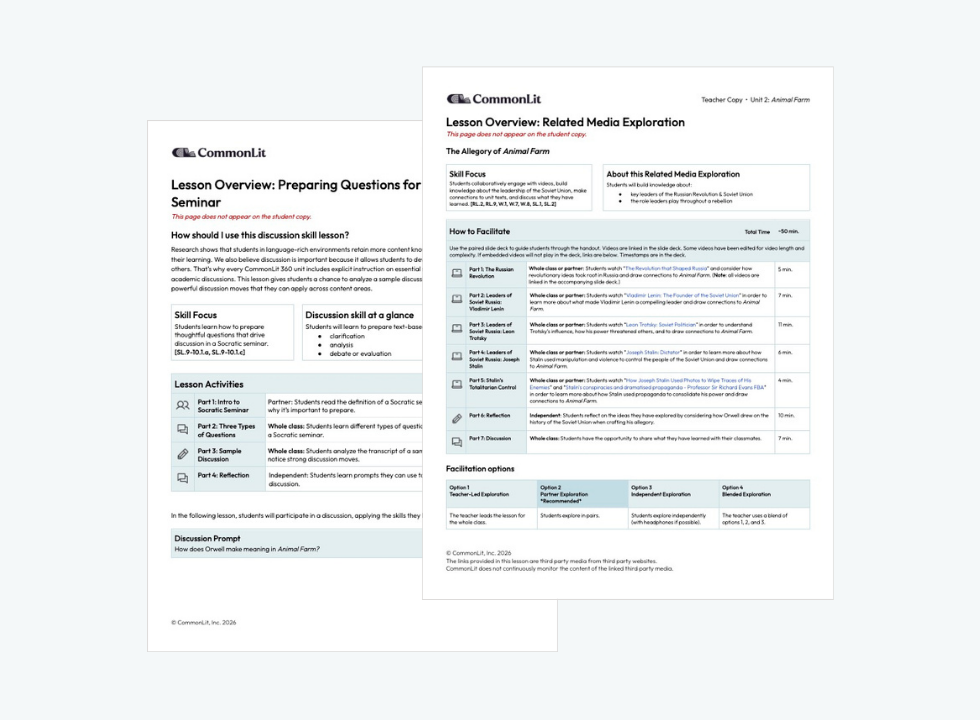
Related Media Explorations: These include curated collections of videos, infographics, timelines, images, and more. Students engage with content they genuinely find interesting, and it gives them the background knowledge they need to read more deeply. In the Animal Farm unit, for example, students build knowledge about the Russian Revolution and life in the early Soviet Union, then make connections to Animal Farm.
Discussion Lessons and Socratic Seminars: Novel units include both discussion skill lessons and structured discussions, including Socratic seminars at the high school level. These lessons go beyond reading and writing to develop students' speaking and listening skills, and they directly support students' preparation for the culminating task.
Additional texts, vocabulary, and grammar: Units also include shorter aligned texts (fiction, nonfiction, and poetry), vocabulary activities, and grammar lessons, all connected to what students are reading and writing.
Building knowledge matters. Even the most well-read students need that extra support to access a text deeply and understand an author's craft and purpose.
Best Practice #3: Plan for Strong Pacing from the Start
One of the most common concerns teachers have about novel units is pacing. Getting through a longer text, along with all the additional lessons, can feel overwhelming, especially when class periods are 45 minutes.
CommonLit 360 has already done much of the pacing work for you. Sample pacing guides are available in the Unit Guide and in the Professional Development tab within the unit. These guides are designed around 45-minute class periods and give you a realistic day-by-day plan.
Here's what strong pacing looks like in practice:
- Day 1: Unit Introduction, vocabulary, the first activity, and the slide deck
- Day 2: Chapter 1 during-reading questions (independent practice may carry into Day 3)
- Day 3: Finish independent practice and continue vocabulary work
- Day 4: Chapter 2 during-reading questions, and so on
A few things to keep in mind: pacing guides are designed for in-class time, with no assumption of homework. If you can assign reading at home, you may be able to move more quickly. And if pacing gets tight, consider prioritizing the most pivotal during-reading questions in a given chapter rather than discussing every question. The goal is depth, not coverage.
Your Most Important Resource
CommonLit 360 provides a wealth of materials, but the most valuable resource in any classroom is the teacher. You're the one who knows your students, makes the facilitation decisions, and brings the novel to life. CommonLit 360 is designed to support those decisions, not replace them.
Next Steps
One of our many goals at CommonLit is to ensure that teachers have the structure, insight, and support needed to help students read and understand grade-level texts. That’s where our team of CommonLit 360 experts come in. Our paid packages support the school and district-level rollout of the CommonLit 360 curriculum with additional assessments, professional learning, and ongoing support.