Powerful Women’s History Month Speeches for Middle and High School Classrooms

These influential speeches help middle and high school students explore women’s leadership, equality, and social change through powerful primary sources.
Women’s History Month is an opportunity to examine the voices of women who challenged injustice and helped shape history. From abolitionists and suffrage leaders to modern advocates for education and gender equality, these speeches show how individuals used language to demand change.
This collection introduces students to important historical moments while giving them the chance to analyze argument, rhetoric, and persuasive techniques in impactful speeches.
Malala Yousafzai’s Address to the United Nations (July 2013) (8th Grade)
Advocacy for girls’ education has become a defining issue in the global fight for equality. In this speech delivered to the United Nations on her sixteenth birthday, Malala Yousafzai argues that education is the most powerful tool for creating equality and improving the world. Students can examine how Malala uses tone, repetition, and word choice to build a persuasive argument about education, peace, and human rights.
Emma Watson’s United Nations Speech: “HeForShe: Gender Equality Is Your Issue, Too” (8th Grade)
Modern conversations about gender equality continue to shape global discussions about rights and opportunity. In this 2014 speech to the United Nations, Emma Watson launches the HeForShe campaign and argues that gender equality should involve men and boys as well as women. Teachers can use this speech to help students trace the development of an argument while discussing feminism, global activism, and the role of public figures in social movements.
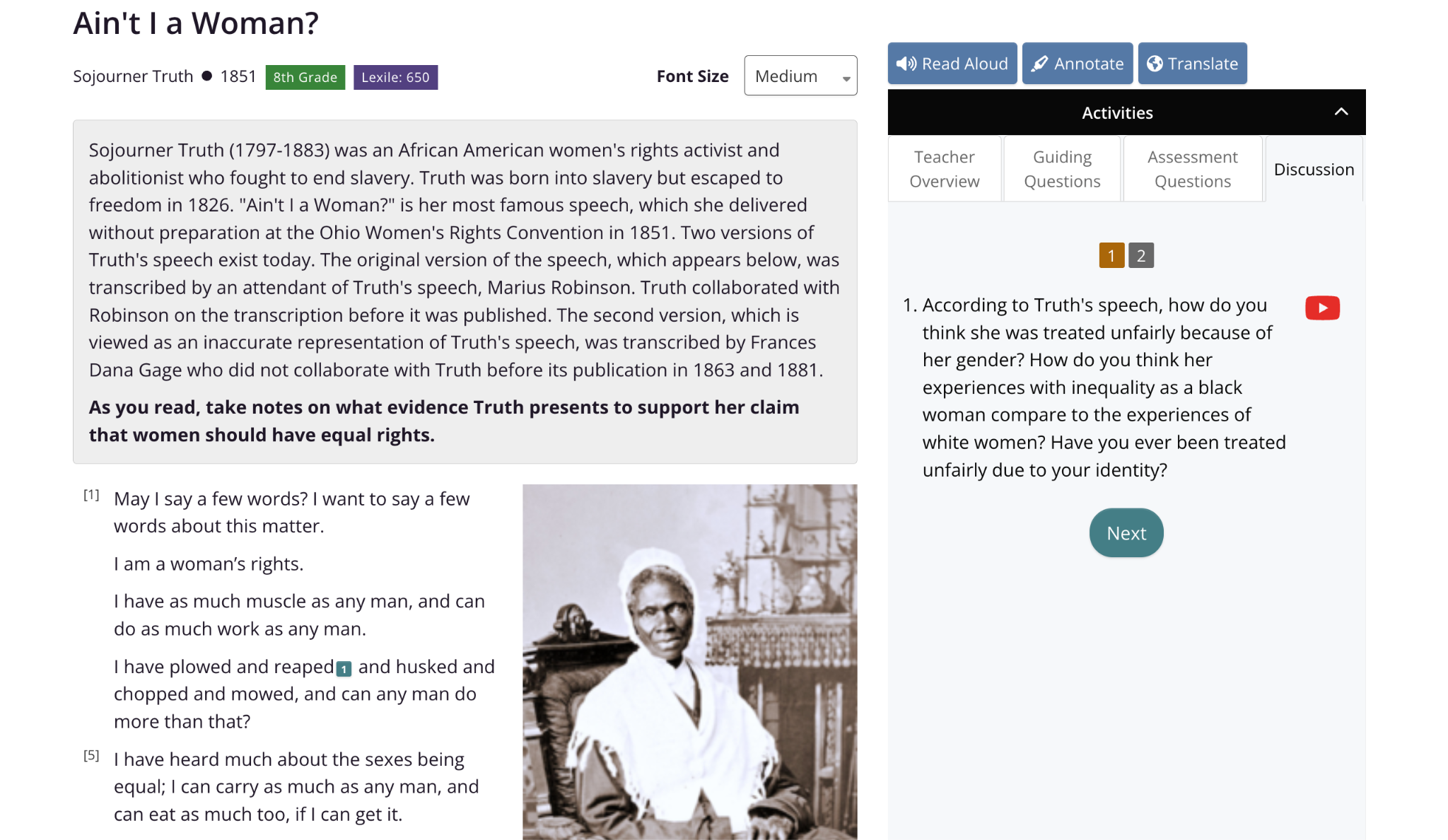
“Ain’t I a Woman?” by Sojourner Truth (8th Grade)
At the 1851 Ohio Women’s Rights Convention, Sojourner Truth delivered one of the most memorable speeches connecting the fight against slavery with the fight for women’s rights. In this speech, Truth argues that women, including Black women, deserve the same rights as men while drawing on personal experience and powerful rhetorical questions. Students can examine how Truth uses repetition and rhetorical questions to strengthen her message and persuade her audience.
Address to Congress on Women’s Suffrage by Carrie Chapman Catt (10th Grade)
The campaign for women’s suffrage relied on leaders who spoke directly to lawmakers about expanding democratic rights. In this 1917 address to Congress, Carrie Chapman Catt argues that granting women the right to vote is inevitable and necessary for the United States to live up to its founding ideals of liberty and equality. Educators can use this speech to help students analyze argument structure and rhetorical appeals such as ethos, pathos, and logos.
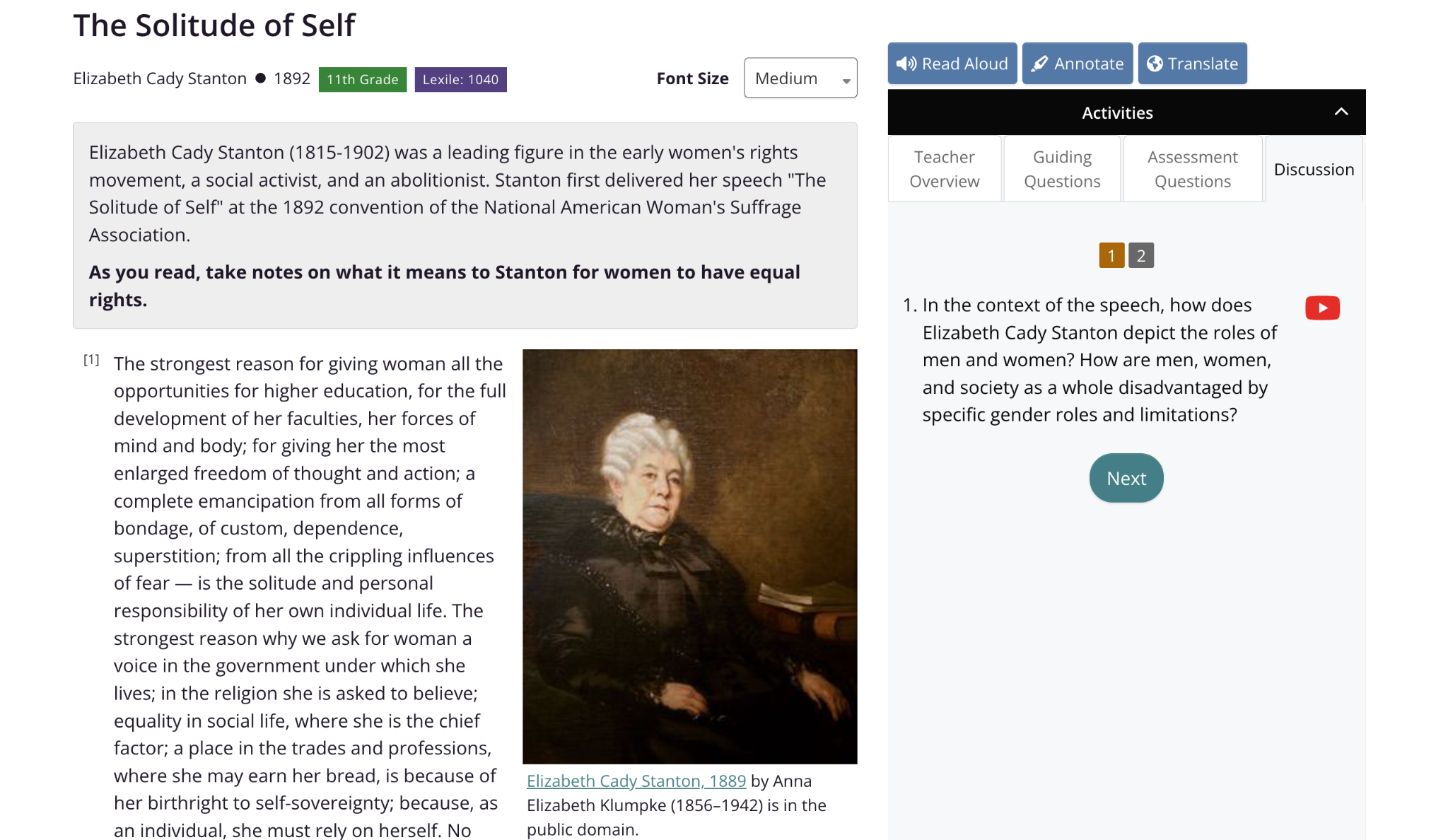
“The Solitude of Self” by Elizabeth Cady Stanton (11th Grade)
Leaders of the women’s suffrage movement often used speeches to argue for women’s independence and equal rights. In this 1892 address to the National American Woman Suffrage Association, Elizabeth Cady Stanton argues that women have the right to independence and the freedom to make their own decisions in life. Students can analyze how Stanton develops her claim through philosophical reasoning and rhetorical devices.
Testimony Before the Senate Hearings on the Equal Rights Amendment by Gloria Steinem (11th Grade)
The push for gender equality continued into the twentieth century through advocacy for constitutional protections. In this testimony supporting the Equal Rights Amendment, Gloria Steinem challenges myths about women’s inferiority and argues that women deserve full constitutional rights. Teachers can guide students in evaluating how Steinem organizes her claims and supports them with evidence and historical comparisons.
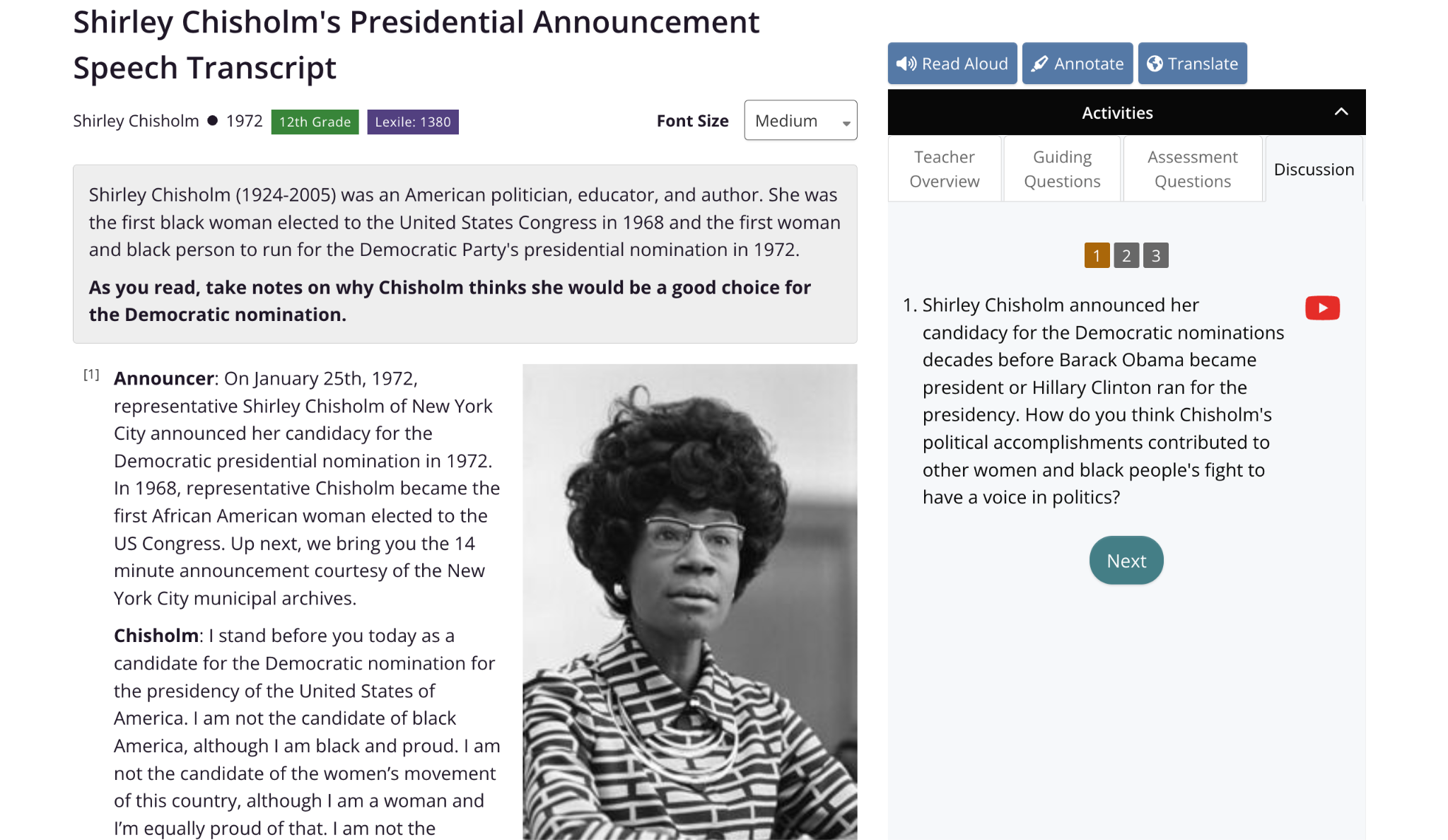
Shirley Chisholm’s Presidential Announcement Speech (12th Grade)
Breaking political barriers has been an important part of women’s leadership in American history. In her 1972 presidential announcement speech, Shirley Chisholm explains why she is running for the Democratic nomination and calls for unity, civic participation, and stronger leadership. Students can analyze how Chisholm builds a persuasive argument about political change while learning about a historic milestone in U.S. politics.
“Why Sit Here and Die” by Maria W. Stewart (12th Grade)
Early nineteenth-century activists connected the fight against slavery with calls for racial and social equality. In this 1832 speech to an abolitionist society, Maria W. Stewart urges African Americans to resist oppression and pursue intellectual and moral improvement in the fight for equality and freedom. The speech offers a strong opportunity for students to analyze rhetorical questions, emotional appeals, and historical context.
Reach More Students with CommonLit
As schools work to strengthen reading proficiency, the CommonLit Text Library offers thousands of engaging texts that connect to the topics students are already exploring in class. Teachers rely on these ready-to-teach passages and discussion questions to support meaningful reading practice across grade levels.
Ready to try it with your students? Log in to your free CommonLit educator account and explore the CommonLit Text Library to assign a text today.
Want to bring CommonLit to your whole school?
Connect with our team to learn how your school can get even more out of CommonLit’s program with a paid partnership. Our partnerships include professional development, assessments, school-wide data reports, and personal support from our team of instructional experts.
