5 Gary Soto Short Stories for Middle School (and What to Teach With Each)

Five free CommonLit short stories from Baseball in April and Other Stories, plus a way to teach each one.
Victor raises his hand to impress a girl and claims he speaks French. Fausto invents a story about a lost dog so he can buy a guitar. Your students have, of course, never stretched the truth to get something they wanted.
Gary Soto's Baseball in April and Other Stories has 11 short stories about kids in exactly these spots: short on money, embarrassed, trying hard, and growing up anyway. Five of them are in CommonLit's free library, and each one gives you something specific to teach.
New to CommonLit? These lessons are free with an educator account. Sign up for one here.
Which Gary Soto short stories can I teach in middle school?
CommonLit's free library includes five stories from Baseball in April and Other Stories by Gary Soto: "Marble Champ," "Growing Up," "Mother and Daughter," "Seventh Grade," and "The No-Guitar Blues." The full collection has 11 stories about everyday teenage life, and these five cover family, growing up, and the small lies kids tell when they want something badly.
"Marble Champ" (Gary Soto, 5th Grade)
Lupe is a shy, straight-A student who has won award after award in academic competitions but isn't much of an athlete. Determined to excel at a sport, she becomes a competitive marbles player, and after weeks of practice, she wins the championship. This story works well for showing how a character's actions build a theme. Ask students to take notes on how Lupe responds to each challenge, then have them use those notes to answer Assessment Question 5: "How do Lupe's thoughts and actions contribute to the theme of the story?"
"Growing Up" (Gary Soto, 6th Grade)
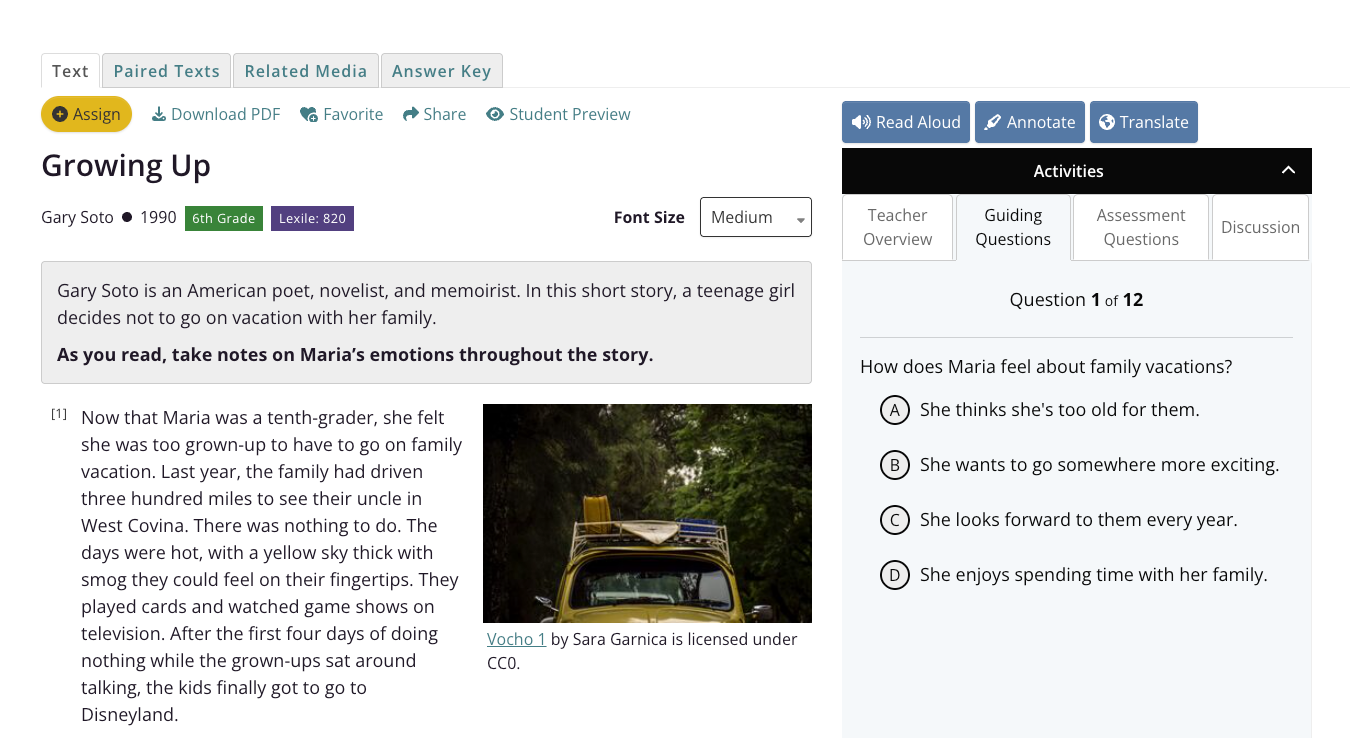
Maria would rather skip this year's family vacation because the last one bored her. After she argues with her father, he reluctantly lets her stay home. Then the guilt kicks in. She worries about her family the whole time and doesn't enjoy her solo week at all. Students can take notes as they read and use them as evidence for Assessment Question 5: "How does Maria's changing attitude emphasize the theme of the short story? Use details from the text to support your answer." It's good practice for rigorous, grade-level reading assessments.
"Mother and Daughter" (Gary Soto, 6th Grade)
Mrs. Moreno can't afford to buy her daughter, Yollie, a new dress for the school dance. She comes up with a plan so Yollie can look her best, feel confident, and have fun with her friends. Use this story to start a conversation about what family means. Ask Discussion Question 2, "In the context of the story, what makes a family?" and have students write their answers before the class discussion if you also want to build writing skills.
"Seventh Grade" (Gary Soto, 6th Grade)
Victor is excited for the new school year because his crush, Teresa, is in several of his classes, including French. When his teacher, Mr. Bueller, asks if anyone knows French, Victor raises his hand to impress her. Then he fumbles through the answers and lands himself in a sticky situation. This one is built for text-to-self connections. Open a class discussion with Discussion Question 1: "Have you ever lied or exaggerated to impress someone? What happened?"
"The No-Guitar Blues" (Gary Soto, 6th Grade)
Fausto wants a guitar, but his parents can't afford one. When he finds a stray dog wearing a collar, he makes up a story to collect a reward from its owners and uses the money toward a guitar. The plan works, but Fausto feels terrible about his white lie and decides to set things right. This story is a strong choice for tracking how a character's attitude changes. Have students note how Fausto feels about his plan as they read, then use those notes for Assessment Question 8: "How does Fausto's attitude about getting a guitar change throughout the story? Use details from the story in your answer."
What Comes With a CommonLit Text?
Every CommonLit text comes with the lesson built around it: questions, discussion prompts, an answer key, a teacher overview, paired texts, and related media, all free with an educator account. Take "Marble Champ" as an example. Each text lists its grade level and Lexile score (5th Grade, Lexile: 850 here). Above the passage, a short note gives context about the author and the short story, plus a prompt that tells students what to track as they read.
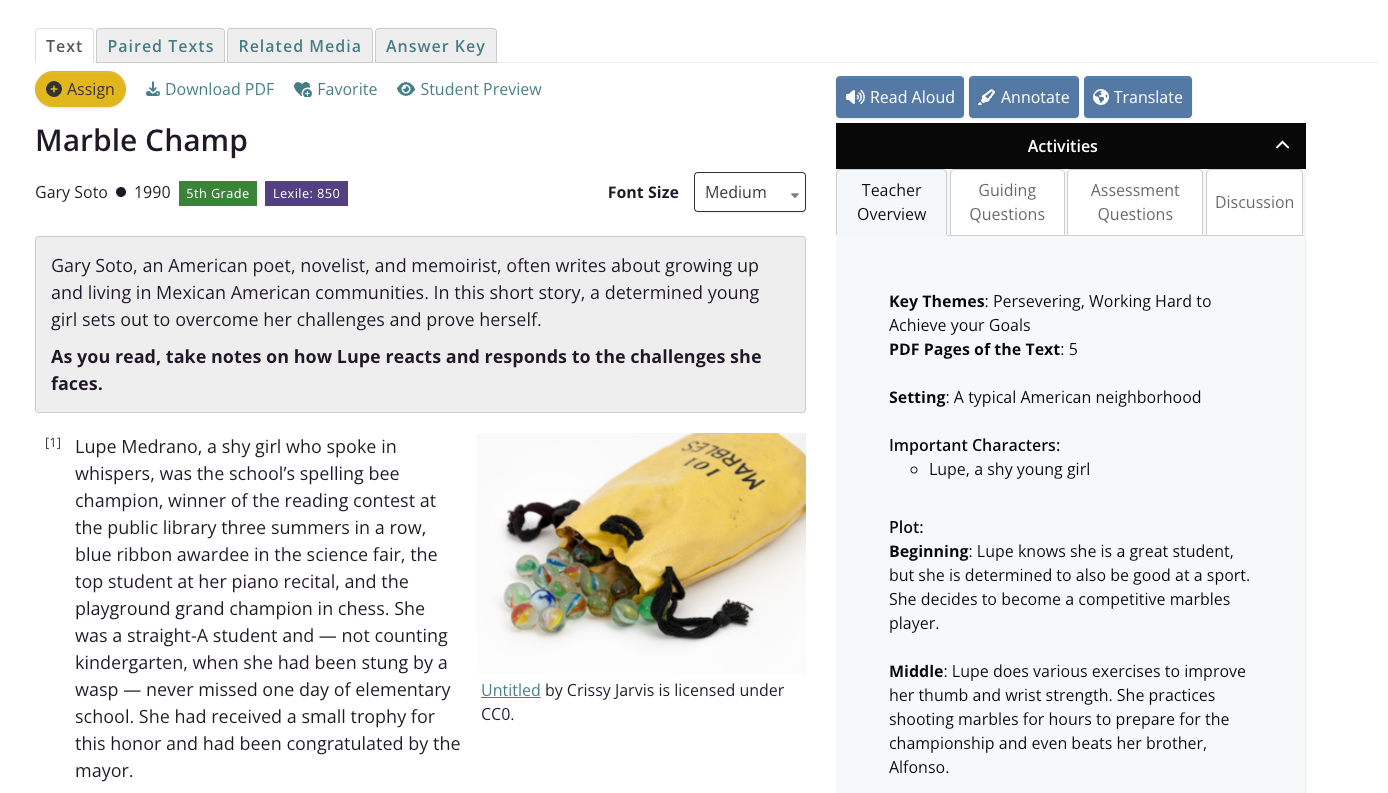
You get the passage and the materials to teach it in one place, and none of it needs building from scratch. Here's what else sits on the page at a teacher’s fingertips:
- Teacher Overview: key themes, setting, important characters, and a beginning, middle, and end plot summary, so you can preview the text before you assign it.
- Guiding Questions, Assessment Questions, and Discussion: three tabs of ready-made questions and prompts in the activities panel.
- Paired Texts: Texts hand-selected by our curriculum team to keep the learning going. These texts come with a quick overview and suggestion for how to pair.
- Student tools: Read Aloud, Annotate, and Translate (30+ languages)
- Assigning options: assign it digitally via Google Classroom, Clever or Class Code. You can also download a PDF, and administer the full lesson to kids offline.
Next steps
All five texts are ready to assign. Create a free CommonLit account to unlock reading questions, assessment questions, answer keys, and paired texts for every lesson. If you want even more Gary Soto texts, browse short stories by Gary Soto in the CommonLit library.
FAQ
How do I help students use evidence when they read Gary Soto's stories?
Have students take notes while they read, then use those notes to answer the Assessment Question. Three of the five stories here ("Marble Champ," "Growing Up," and "The No-Guitar Blues") follow that pattern, each tied to a question about how a character's thoughts, actions, or attitude connect to the story's theme or change over time. The other two ("Mother and Daughter" and "Seventh Grade") are set up for discussion, so students can connect the story to their own lives before they write.
Are these Gary Soto stories free?
Yes. Every text in the CommonLit Text Library is free with an educator account, including reading questions, assessment questions, answer keys, and paired texts. Go to CommonLit.org, click "Sign Up," choose "I Am an Educator," and confirm your school email.
Are these Gary Soto stories authentic texts I can trust for my classroom?
Yes. An “authentic text” is writing by a real author rather than a passage written to fit a worksheet, and all five of these stories are Gary Soto's own, from his short story collection Baseball in April and Other Stories. CommonLit's curriculum team curates the Text Library and builds each lesson around the text, with reading questions, assessment questions, and an answer key, so the supports are ready when you are. CommonLit is a nonprofit, and the Text Library is free with an educator account.
Can I print these lessons?
Yes. Each text can be downloaded as a PDF or assigned digitally to students.
What grade levels does the CommonLit Text Library cover?
The CommonLit Text Library includes lessons spanning grades 3-12. Browse the grades 6-8 collection here.
