
If you’re looking at a new ELA curriculum, you’ve probably seen the term “knowledge-building” more than once. It’s become one of the most common ways curricula describe themselves, and there’s a reason for that. Research consistently shows that what students already know about a topic shapes how well they understand what they read about it.
So what does a knowledge-building ELA curriculum actually look like in practice? This post explains what it is, how it differs from a skills-first approach, and what to look for when you’re choosing one for your classroom or school.
What is a knowledge-building ELA curriculum?
A knowledge-building ELA curriculum is one that organizes reading around connected topics, so students build deep background knowledge as they practice literacy skills. Instead of reading a random passage to practice “main idea” one week and “inference” the next, students read several related texts on the same topic or theme over weeks.
Each text adds to what students already know. By the end of a unit, they’ve built a mental framework they can use to read harder texts, join richer discussions, and write with real evidence.
Why does background knowledge matter for reading comprehension?
Background knowledge matters because readers use what they already know to make sense of what’s on the page. As cognitive scientist Daniel Willingham explains in “How Knowledge Helps,” writing is full of gaps that readers fill in with what they already know. He points to a classic study in which middle schoolers who knew a lot about baseball understood a passage about a baseball game better than students who didn’t, even when the baseball fans were weaker readers.
This changes how we think about comprehension. Skills like inferencing and summarizing still matter, but students can only apply them well when they understand the content. Knowledge gives skills something to grip.
- Vocabulary grows faster when words show up again and again in related texts.
- Students read more complex texts once a topic feels familiar.
- Discussions get deeper because everyone shares a common base of knowledge.
How is knowledge-building different from a skills-based curriculum?
The core difference is what drives text selection. In a skills-based model, the skill comes first, and texts are chosen to practice it. In a knowledge-building model, the topic or question comes first, and skills are taught through a carefully sequenced set of texts that build on each other.
Skills don’t disappear in a knowledge-building curriculum. Students still learn to analyze theme, cite evidence, and write strong arguments. They practice those skills while building knowledge about the world around them.
What should you look for in a knowledge-building ELA curriculum?
A knowledge-building curriculum should include cohesive text sets that build knowledge, one of the features EdReports, the independent nonprofit that reviews instructional materials, evaluates in its ELA reviews. EdReports and the Knowledge Matters Campaign both publish criteria for evaluating these curricula, and their lists share a few key features:
- Text sets organized around topics or themes, so each reading adds to the last.
- A high volume of reading in complex, content-rich texts.
- Text-based questions, discussion, and writing that keep students working with what they’ve read.
- Systematic vocabulary instruction focused on high-value academic words.
- Culminating tasks that ask students to apply the knowledge and skills from a unit.
Finding a curriculum that checks all five boxes is hard enough. Finding one that fits your budget can be harder.
Is there a free knowledge-building ELA curriculum?
Yes. CommonLit 360 is a free, full-year secondary English Language Arts curriculum designed to support student growth in reading, writing, speaking, and listening. Its texts give students a foundation of knowledge about the world and help them build on it, so they can better understand and take part in communities beyond their own classrooms.
Here’s how CommonLit 360 meets those criteria:
- Topic-based units: Each unit focuses on a concept or theme through a thought-provoking essential question, and units build on each other over the course of the year.
- Complex, content-rich texts: Texts are chosen for their meaning, complexity, and richness, and they serve as mentor passages for writing lessons.
- Text-based discussion and writing: Students discuss what they’re reading every day, and discussion skill lessons explicitly teach the speaking and listening skills they need for academic conversation. Each reading, writing, and discussion lesson ends with a short written response.
- Vocabulary instruction: Unit vocabulary words come from the unit texts and connect to unit topics and themes. Students practice the words through a series of activities and a quiz, and key words are highlighted and defined in every reading lesson.
- Culminating tasks: Every unit ends with a culminating task, such as an essay, a presentation, or a research project, that asks students to apply the knowledge and skills they’ve built.
In 6th grade, for example, students move from an informational unit, The Recipe for Success, through a novel study of The Giver, to a research unit called Our Changing Oceans. You can see how every grade fits together in the full CommonLit 360 Scope and Sequence.
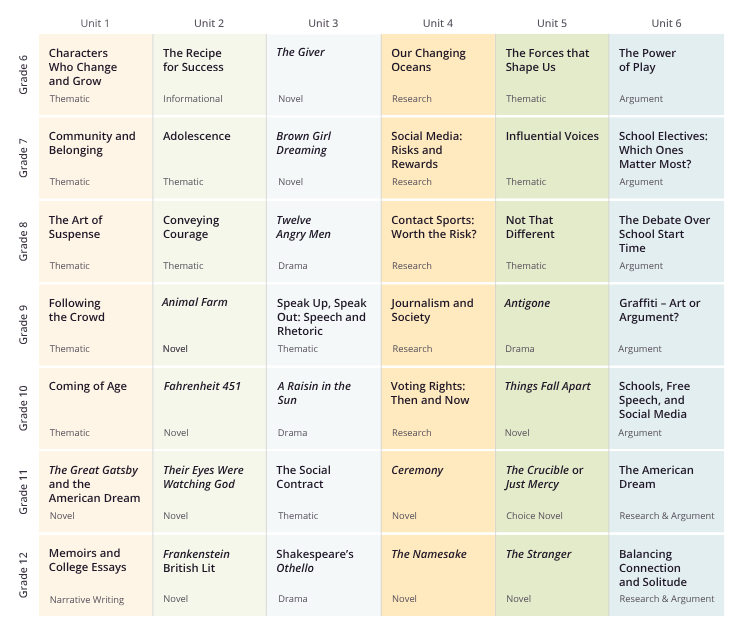
CommonLit 360 for grades 6-8 is also rated all-green by EdReports, meaning it meets expectations across alignment, building knowledge, and usability.
New to CommonLit? CommonLit 360 is free with an educator account.
Frequently Asked Questions
What is a knowledge-building curriculum?
A knowledge-building curriculum organizes reading around connected topics, so students build background knowledge and literacy skills at the same time.
Does a knowledge-building curriculum still teach reading skills?
Yes. Students still learn skills like analyzing theme, citing evidence, and writing arguments. They practice those skills through connected texts instead of isolated passages.
What is CommonLit 360?
CommonLit 360 is a comprehensive English Language Arts curriculum for grades 6-12 that is designed to drive student growth in reading, writing, speaking, and listening skills. Each grade level has 6 units of instruction that are horizontally and vertically aligned.
Is CommonLit 360 a knowledge-building curriculum?
Yes. Every CommonLit 360 unit is built around an essential question, with core texts that connect to it and build on knowledge from earlier units.
Is CommonLit 360 free?
Yes. CommonLit 360 is free for teachers with a CommonLit educator account.
Next Steps
If you’re thinking about bringing a knowledge-building curriculum into your classroom, a good first step is to see one in action. Start with the CommonLit 360 Scope and Sequence to see how the units build across your grade level. Then open a unit and look at how the texts, discussions, and writing all point toward the same essential question.
Teachers: Explore CommonLit 360 and see how each unit builds knowledge from the first lesson to the Culminating Task. Create a free CommonLit account to unlock full units, reading questions, and answer keys, all ready to teach.
