10 Short Stories Elementary School Teachers Love (and What to Teach With Each)

Ten free CommonLit short stories for 3rd, 4th, and 5th grade, from a goldfish named Dog to a marbles championship, plus what each one teaches best.
A girl asks for a dog, gets a goldfish, and names it Dog in protest. Your third graders will understand her completely.
In fact, all 10 of these stories from CommonLit’s free Text Library share that in common: relatability. They range from a basketball rivalry to a rooftop under a smog-covered sky, and each one comes with the skill it teaches best. Three are labeled for 3rd grade, three for 4th, and four for 5th. Pick one for a single lesson, or build a short fiction unit from three or four.
New to CommonLit? These lessons are free with an educator account. Sign up for one here.
Which short stories work well for 3rd grade?
"A Fish Named Dog," "Impossible to Train," and "MVP" are three 3rd grade short stories on CommonLit that cover learning a lesson, humor and twist endings, and teamwork. Each is free with an educator account.
"A Fish Named Dog" by Christyne Morrell (3rd Grade)
When the narrator asks for a dog and gets a goldfish instead, she names it "Dog" in protest. While she complains to her friend that everyone else got a real dog, Dog swims toward her every time she says its name, and she starts to wonder if it's more special than she thought. Use it to practice finding a lesson in a story. After reading, students can answer Assessment Question 4: "What lesson does the narrator learn from the fish named Dog?" The question helps them see how she came to appreciate the goldfish she'd underestimated.
"Impossible to Train" by David Hill (3rd Grade)
Bea, Jesse, and Sammy describe how hard their pets are to train, and what they love about them. Then comes the twist: Bea, Jesse, and Sammy are the pets, talking about their human owners. The humor and the ending make this a good pick for a unit on animals and the relationship between humans and animals. You can find more texts about pets for elementary students in CommonLit's free digital library.
"MVP" by Clare Mishica (3rd Grade)
Derek is determined to outscore his teammate Cole and be named his basketball team's MVP, or most valuable player. When Cole sprains his ankle and sits out, Derek realizes Cole had been helping him become a better player. With minutes left in the championship game, Derek focuses on helping his team win and leans on his teammates. This is a strong text for teaching teamwork and how much students can accomplish together. Start a discussion with Discussion Question 1: "How does working together help the narrator's basketball team win? Describe a time when you worked with others and how it helped you accomplish a goal."
Which short stories work well for 4th grade?
"An Honest Mistake," "Stray," and "Tamitha and the Dragon" are three 4th Grade short stories on CommonLit that cover honesty, point of view, and perseverance. Each is free with an educator account.
"An Honest Mistake" by Karen Meissner (4th Grade)
Karie wins a prize for a perfect score on her spelling test. After she shares the news with her mom, she realizes she misspelled the word "honestly." Now she has to decide whether to tell her teacher and give the prize back. It's a good fit for a character development unit. Ask students Assessment Question 5: "What do Karie's thoughts and actions show what kind of person she is?" The question pushes them to explore the story's moral and why being truthful matters.
"Stray" by Cynthia Rylan (4th Grade)
Doris finds a stray puppy outside her house during a snowstorm, and her parents let her keep it in the basement until the snow clears. The snow keeps falling, and when Doris pleads to keep the puppy, her parents say they can't afford it. After nine days of snow, her father takes the dog to the pound. Doris locks herself in her room until dinner, when a surprise is waiting. Have students take notes on how Doris and her parents see the situation, then try Assessment Question 5: "How does the change in the father reveal the theme in the story?" It's a good way to show how pets can bring out the best in people.
"Tamitha and the Dragon" by Elizabeth C. Desimone (4th Grade)
A dragon snatches Tamitha and makes her clean his castle or face his wrath. She meets other creatures with problems of their own, and after several failed escape attempts, she and the creatures find a way to trick the dragon into cleaning his own castle. Tamitha is a girl full of grit, which makes this a great pick for teaching perseverance. Ask Discussion Question 1: "Have you ever tricked someone for their own good? If you have not tricked someone before, do you think it is ever okay to trick someone like Tamitha did?" The question helps students see why her character traits help her overcome difficulties.
Which short stories work well for 5th grade?
"Her Hands That Held the Stars," "Sometimes a Dream Needs a Push," "Eleven," and "Marble Champ" are four 5th Grade short stories on CommonLit that cover science fiction, family support, feeling powerless, and reading in two languages. Each is free with an educator account.
"Her Hands That Held the Stars" by Rebecca Birch (5th Grade)
In this science fiction story, the sky is covered by eversmog in a polluted future, and Akeisha is determined to see the stars. She sneaks up to the rooftop, where her Nana points out the stars glimmering in her hands. Akeisha decides to find a way to share the sky she sees with everyone. Use it to help students connect science fiction to real life. Start a discussion with Discussion Question 2: "Science fiction writers often write stories because they want us to think about our own world and what we value. Could we one day be living in a world that is similar to the setting of this story? Why or why not?" Encourage students to support their thinking with the text and their own experiences.
"Sometimes a Dream Needs a Push" by Walter Dean Myers (5th Grade)
After a car accident leaves Chris unable to walk, he joins a wheelchair basketball team. His dad, who blames himself for the accident, helps the team by showing them how to shoot better. The team loses a big game, but Chris is proud of their hard work and glad to have his dad's support. The complex relationship between Chris and his dad makes this a strong text for analyzing character development and making connections. Ask Discussion Question 3: "In the context of the text, what makes a family? What are some of the experiences you have had where the support of family and friends made a significant difference?"
"Eleven" by Sandra Cisneros (5th Grade)
Rachel is 11, and her teacher, Mrs. Price, insists that a red sweater from the lost and found belongs to her. Rachel can't find the words to say it doesn't, and she wishes she were older so an adult's word wouldn't feel so powerful. The narrator's internal monologue captures what it's like to be 11. Have students follow the annotation task, which asks them to take notes on how the narrator reacts to the red sweater, then use the annotation tool for evidence in their short answers on the reading assessment. Afterward, lead a discussion and ask for text-to-self connections: have they ever felt powerless because of their age?.
What comes with a CommonLit text?
Every CommonLit text comes with the lesson built around it: questions, discussion prompts, an answer key, a teacher overview, paired texts, and related media, all free with an educator account. Take the "A Fish Named Dog" as an example. Each text lists its grade level and a lexile level; this text is for 3rd graders and has a lexile of 660. Above the passage, a short note gives context about the author and the text, plus a prompt that tells students what to track as they read.
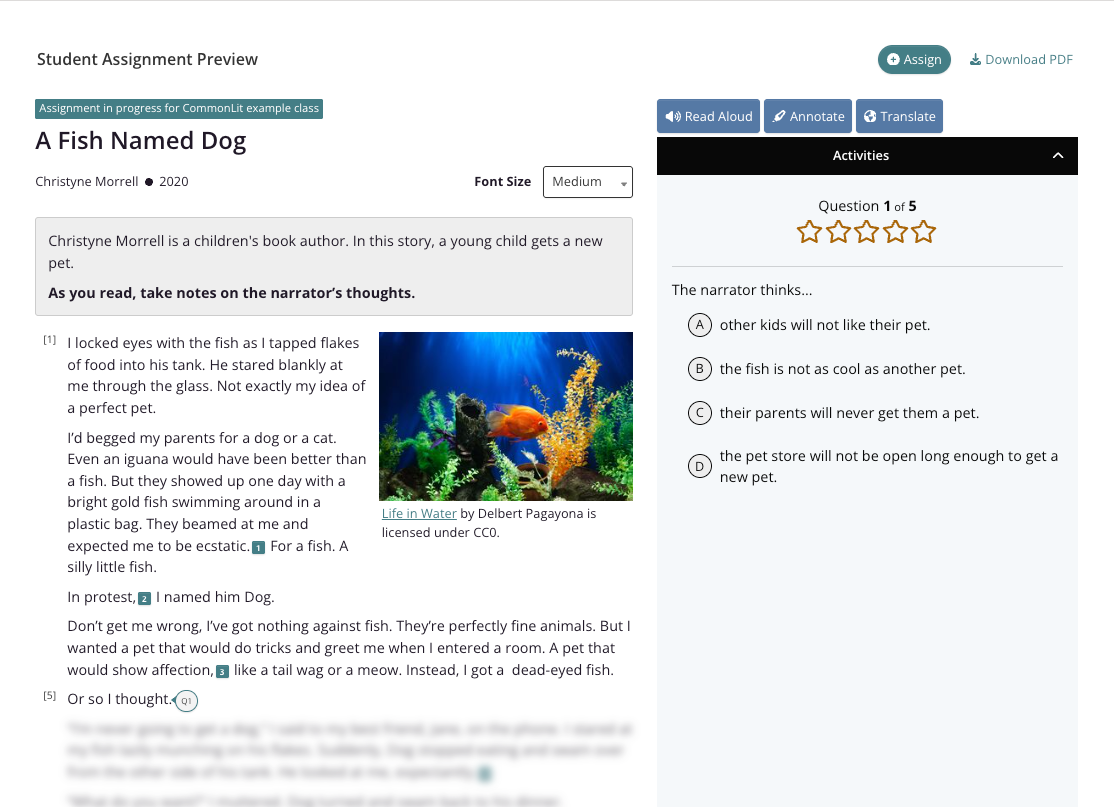
You get the passage and the materials to teach it in one place, and none of it needs building from scratch. Here's what else sits on the page at a teacher's fingertips:
- Teacher Overview: key themes, setting, important characters, and a beginning, middle, and end plot summary, so you can preview the text before you assign it.
- Guiding Questions, Assessment Questions, and Discussion: three tabs of ready-made questions and prompts in the activities panel.
- Paired Texts: Texts hand-selected by our curriculum team to keep the learning going. These texts come with a quick overview and suggestion for how to pair.
- Student tools: Read Aloud, Annotate, and Translate (30+ languages)
- Assigning options: assign it digitally via Google Classroom, Clever or Class Code. You can also download a PDF, and administer the full lesson to kids offline.
Next Steps
All 10 texts are ready to assign. Create a free CommonLit account to unlock reading questions, assessment questions, answer keys, and paired texts for every lesson. Want more? Browse elementary texts in the CommonLit Library.
Frequently Asked Questions
Are these short stories free?
Yes. Every text in the CommonLit Text Library is free with an educator account, including reading questions, assessment questions, answer keys, and paired texts. Go to CommonLit.org, click "Sign Up," choose "I Am an Educator," and confirm your school email.
Are these authentic texts I can trust for my elementary classroom?
Yes. ”An authentic text” is writing by a real author rather than a passage written to fit a worksheet. The texts in this list come from authors including Sandra Cisneros, Walter Dean Myers, and Gary Soto. CommonLit's curriculum team curates the Text Library and builds each lesson around the text, with reading questions, assessment questions, and an answer key, so the supports are ready when you are. CommonLit is a nonprofit, and the Text Library is free with an educator account.
Can I print these lessons?
Yes. Each text can be downloaded as a PDF or assigned digitally to students.
What grade levels does the CommonLit Text Library cover?
The CommonLit Text Library includes lessons spanning grades 3-12. Once you log in to your free educator account, you can browse the 3rd, 4th, and 5th grade collection to find more stories like these.
Which of these short stories work best for teaching character development?
"An Honest Mistake" and "Sometimes a Dream Needs a Push" both work well for character development. "Stray" goes a step further with an assessment question on how the father's change reveals the theme.
