10 Free Short Stories for Middle School Students (and What to Teach With Each)

A roundup of 10 free CommonLit short stories for grades 6-8, with what each one is best for teaching.
A good short story can get a room of 12-year-olds arguing before the bell and still debating in the hallway. The trick is finding one that's a quick read but gives students plenty to talk about.
These 10 stories do both. They range from a boy and a caterpillar in a classroom jar to a barber with a razor and a military captain in his chair. Each one has a clear teaching focus, from symbolism to tension to characterization.
New to CommonLit? These lessons are free with an educator account. Sign up for one here.
Which short stories work well for 6th grade?
"Inside Out," "My Side of the Story," and "Unusual Normality" are three 6th Grade short stories on CommonLit that cover symbolism, sibling conflict, and gratitude. Each is free with an educator account.
"Inside Out" by Francisco Jiménez (6th Grade)
Francisco doesn't speak English, and school feels like a place he doesn't fit. What he does notice is the caterpillar living in a jar in the classroom. By the time it becomes a butterfly, Francisco has settled in and his artistic talent has been recognized. It's a clean pick for teaching symbolism, since the butterfly's metamorphosis mirrors Francisco's own growth.
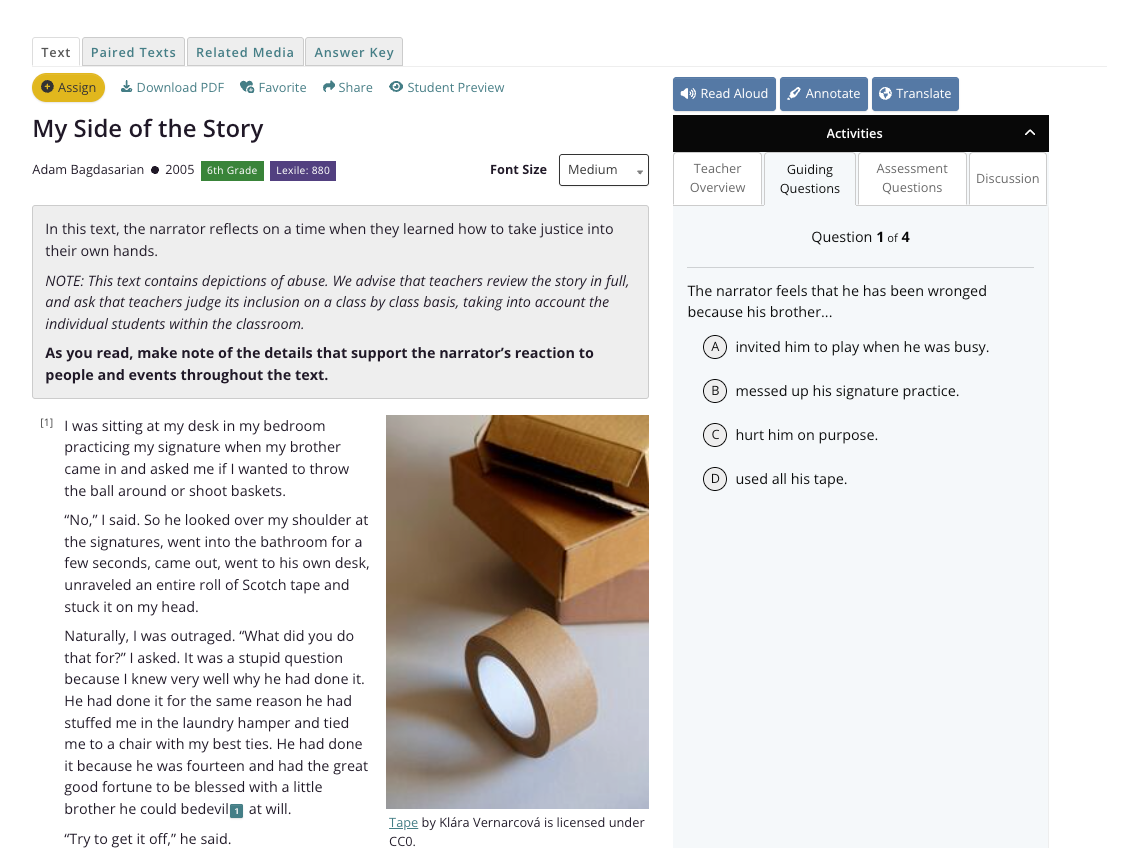
"My Side of the Story" by Adam Bagdasarian (6th Grade)
The narrator's older brother, Skip, sticks tape on his head, so he goes to tell his mother. He runs into his father instead, who yells at him and not at Skip. The narrator breaks Skip's baseball trophy, hoping his brother will make the same mistake of complaining to their father. Students with siblings will recognize the pursuit of justice right away.
"Unusual Normality" by Ishmael Beah (6th Grade)
In this memoir, Ishmael Beah describes adjusting to life in America after serving as a child soldier in Sierra Leone. His new school friends invite him to play paintball, and they're amazed at how good he is at their games of war. Beah has to decide whether to reveal his past or stay quiet and enjoy being seen as a kid. Use it to get students thinking about what they take for granted and how they might express gratitude for what they have.
Which short stories work well for 7th grade?
"Button, Button," "The Party," "The Save," and "The Fan Club" are four 7th Grade short stories on CommonLit that cover tension, social conflict, and the roles of luck and skill. Each has an ending that gives students something to argue about.
"Button, Button" by Richard Matheson (7th Grade)
Nora and Arthur Lewis receive a package containing a mysterious button. A man named Mr. Steward explains that if they push it, someone they don't know will die and they'll receive $50,000. Arthur is horrified. Nora is intrigued. She pushes the button, and Arthur dies. When she calls Mr. Steward, he asks whether she really knew her husband. The shocking twist makes this a strong text for studying how authors build tension through character interaction and conflict.
"The Party" by Pam Muñoz Ryan (7th Grade)
The narrator isn't invited to the popular girl's party, and she spends the day at school resenting how much power Bridget has over her mood. Then Bridget invites her, and the narrator has to decide whether she actually wants to go. She never reveals her decision, so expect your students to debate whether she accepts and why.
"The Save" by Joseph Bruchac (7th Grade)
Oren is a third-string lacrosse goalie who wishes he were better at the sport his ancestors, the Iroquois, invented. He makes a great save and his team celebrates, but Oren is sure it was dumb luck. His grandfather says Oren has good reflexes, and Oren proves it moments later by saving his grandfather from flying metal shards. Students will have plenty to say about the roles of luck, bravery, and skill.
"The Fan Club" by Rona Maynard (7th Grade)
Laura's popular classmates think she's weird, and she's convinced Diane, Terri, and Steve are plotting to humiliate her. They're actually preparing to embarrass Rachel, a loner who's also seen as odd. Laura then chooses to join in mocking Rachel. That twist ending leads straight into discussions about integrity and fitting in.
Which short stories work well for 8th grade?
"Lather and Nothing Else," "The Stone Boy," and "The Last Dog" are three 8th Grade short stories on CommonLit that center on internal conflict, characterization, and character development. All three involve a character whose sense of self shifts over the course of the story.
"Lather and Nothing Else" by Hernando Téllez (8th Grade)
Set during the Colombian civil war, this story follows a barber shaving a military captain's beard. The barber is a clandestine revolutionary, and he spends the whole shave wrestling with whether to kill the captain. It's a strong text for analyzing internal conflict, since the barber swings between seeing himself as a murderer and seeing himself as a hero.
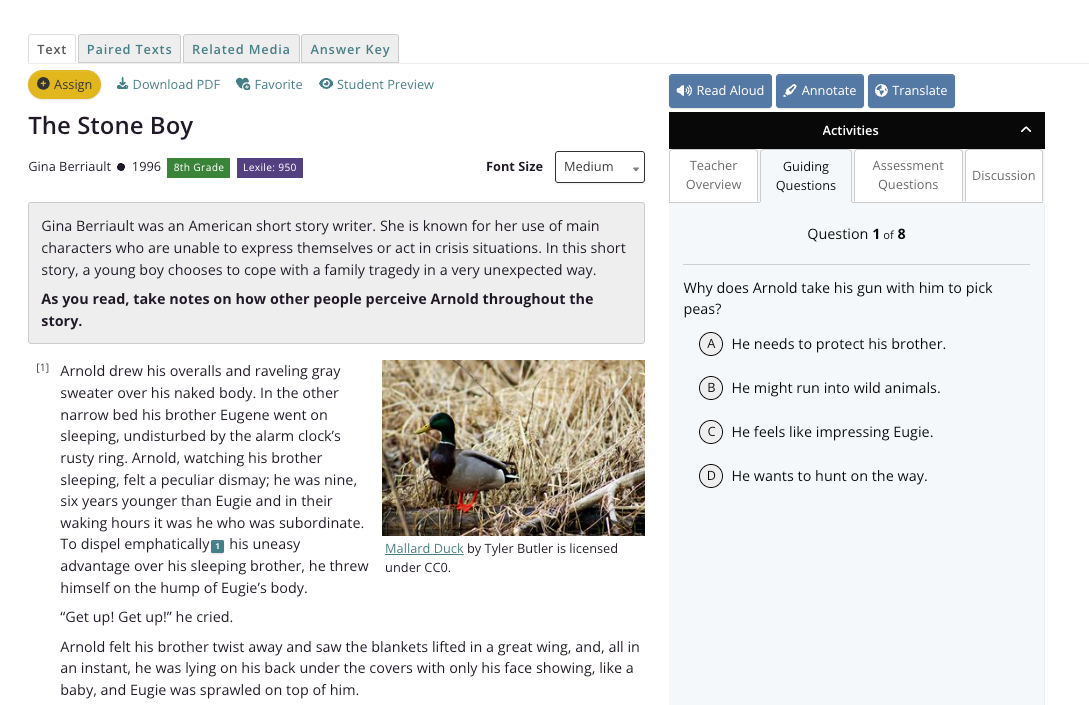
"The Stone Boy" by Gina Berriault (8th Grade)
Arnold accidentally shoots his older brother, Eugie. Instead of running for help, he goes to pick peas. The adults around him are stunned and begin to label him as cold and mean, and eventually Arnold starts to see himself as emotionless too. It's a good fit for teaching characterization, because Arnold's identity is shaped by how others see him.
"The Last Dog" by Katherine Paterson (8th Grade)
In a dystopian future, Brock leaves the dome that protects his community from the poisonous atmosphere outside. He finds a puppy that has lost her mother and brings her home. When scientists want to experiment on her, Brock is determined to save her. Use it to analyze character development, as Brock's tightly controlled life changes because of his love for the puppy.
What Comes With a CommonLit Text?
Every CommonLit text comes with the lesson built around it: questions, discussion prompts, an answer key, a teacher overview, paired texts, and related media, all free with an educator account. Take "Button, Button" as an example. Each text lists its grade level and Lexile score (7th Grade, Lexile: 420 here). Above the passage, a short note gives context about the author and the excerpt, plus a prompt that tells students what to track as they read.
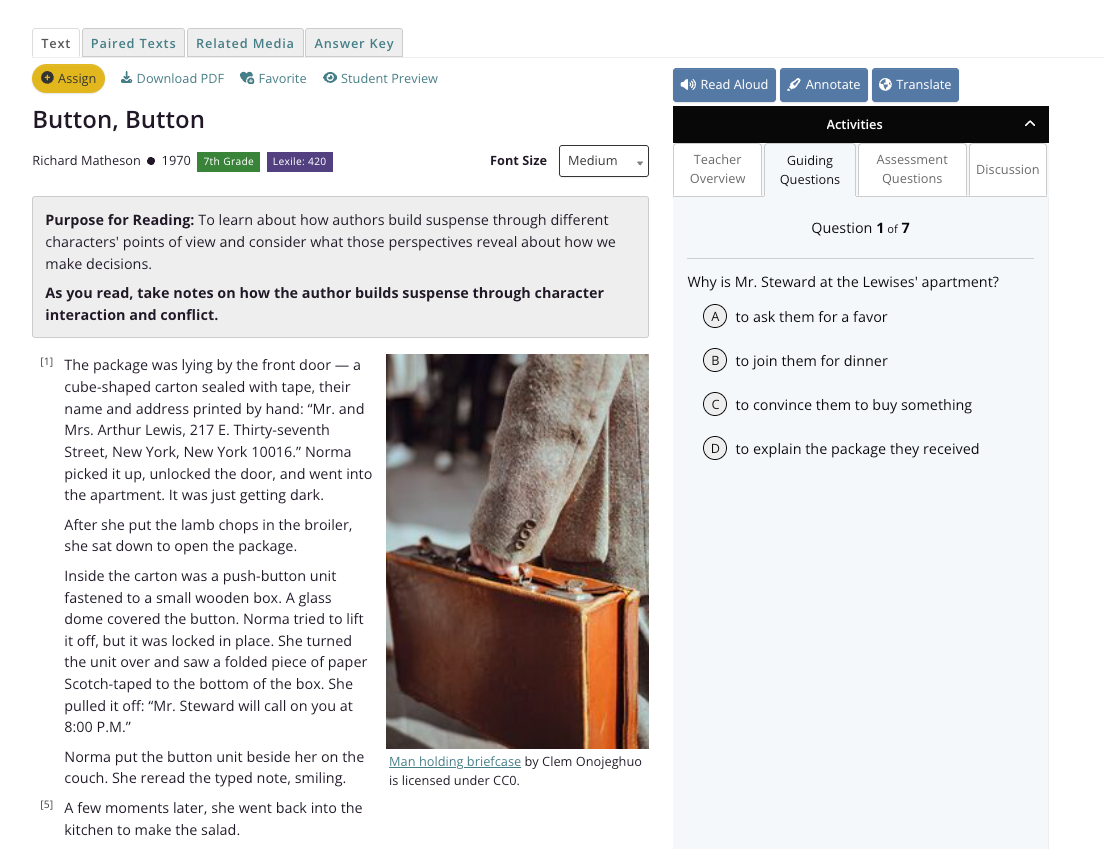
You get the passage and the materials to teach it in one place, and none of it needs building from scratch. Here's what else sits on the page at a teacher’s fingertips:
- Teacher Overview: key themes, setting, important characters, and a beginning, middle, and end plot summary, so you can preview the text before you assign it.
- Guiding Questions, Assessment Questions, and Discussion: three tabs of ready-made questions and prompts in the activities panel.
- Paired Texts: Texts hand-selected by our curriculum team to keep the learning going. These texts come with a quick overview and suggestion for how to pair.
- Student tools: Read Aloud, Annotate, and Translate (30+ languages)
- Assigning options: assign it digitally via Google Classroom, Clever or Class Code. You can also download a PDF, and administer the full lesson to kids offline.
Next steps
All 10 texts are ready to assign. Create a free CommonLit account to unlock reading questions, assessment questions, answer keys, and paired texts for every lesson. Teaching older students too? Try 10 Free Short Stories for High School Students (and What to Teach With Each), or browse the full CommonLit Text Library.
Create a free account on CommonLit!
Frequently Asked Questions
Are these texts free?
Yes. Every text in the CommonLit Text Library is free with an educator account, including reading questions, assessment questions, answer keys, and paired texts. Go to CommonLit.org, click "Sign Up," choose "I Am an Educator," and confirm your school email. Each text can be downloaded as a PDF or assigned digitally to students.
Are these short stories authentic texts I can trust for my middle school classroom?
Yes. An “authentic text” is writing by a real author rather than a passage written to fit a worksheet. The texts in this list come from authors including Richard Matheson, Ishmael Beah, Katherine Paterson, and Francisco Jiménez. CommonLit's curriculum team curates the Text Library and builds each lesson around the text, with reading questions, assessment questions, and an answer key, so the supports are ready when you are.
What grade levels does the CommonLit Text Library cover?
The CommonLit Text Library includes lessons spanning grades 3-12.
Which short story is best for teaching symbolism?
"Inside Out" by Francisco Jiménez is a strong choice for teaching symbolism. The caterpillar in the classroom jar becomes a butterfly, and that metamorphosis represents Francisco's growth.
Which of these short stories have a twist ending?
"Button, Button" by Richard Matheson and "The Fan Club" by Rona Maynard both end with a twist. In "Button, Button," Nora pushes the button and Arthur dies. In "The Fan Club," Laura chooses to take part in mocking Rachel.
