Elementary Classrooms Secondary Classrooms What Is a Baseline Reading Assessment, and When Should You Give One?

A practical guide to what baseline reading assessments measure, why they matter, and how to time them so the data actually shapes your instruction.
Planning reading instruction without data means a lot of guesswork. You might know which students enjoy reading, but that won't tell you how those students are performing relative to others across the country.
A baseline reading assessment shows you exactly that. It measures where students' reading comprehension stands before instruction begins, so you can plan your lessons and measure growth against it all year.
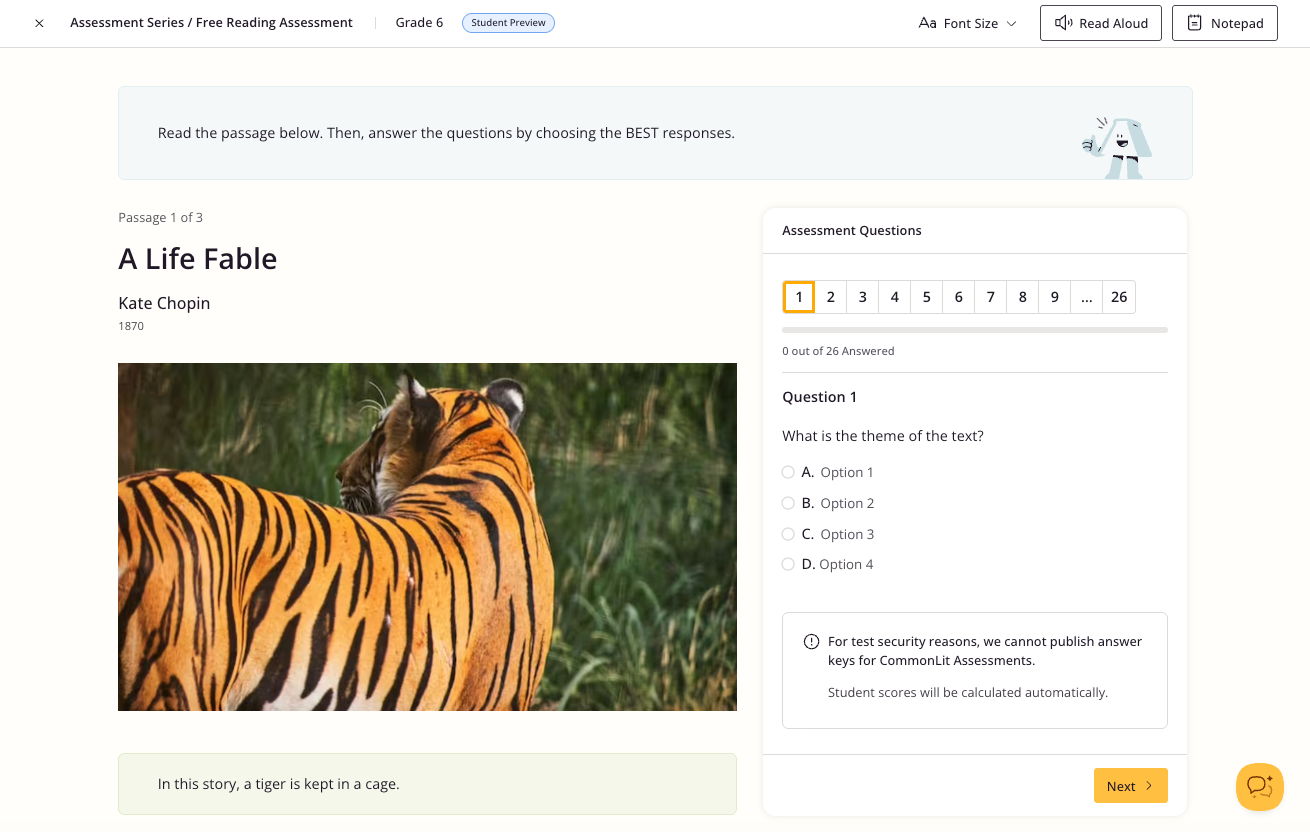
CommonLit's Free Reading Assessment is a one-time baseline assessment for students in grades 3-12, and is available to everyone with a free CommonLit educator account.
Below, you'll learn what a baseline reading assessment measures, when to give one, and how to turn the results into your next teaching moves.
What is a baseline reading assessment?
A baseline reading assessment is a short test given at the start of a school year or semester to measure where students' reading comprehension stands before instruction begins. It's not a grade, it's a snapshot.
Most baseline assessments ask students to read grade-level passages and answer questions tied to core reading standards, such as citing evidence, finding central ideas, and analyzing word choice. The results show how your students performed relative to same-grade peers across the country.
Why does a baseline reading assessment matter?
A baseline assessment matters because you can't measure growth without a starting point. If you don't know where students began in September, it's hard to show how far they've come by May, or to spot who has stalled.
Baseline data, alongside other information about students, helps you:
- Plan with purpose. Look ahead to coming lessons and units and consider how you might provide support for students, groups of students, or classes.
- Catch quiet strugglers early. Some students hide reading difficulties well. Data doesn't miss them.
- Talk about progress with evidence. Families, coaches, and administrators can all see where students started.
When should you give a baseline reading assessment?
Give a baseline reading assessment within the first two to three weeks of the school year or semester, once routines are in place but before core instruction gets going.
Timing matters for two reasons. Too early, and students are still learning logins, seating charts, and your name. Too late, and the results reflect your teaching as much as their starting point.
A few practical tips:
- Protect the time. Plan for one uninterrupted class period.
- Set the tone. Tell students it's not graded and helps you teach them better. That lowers anxiety and leads to more honest results.
- Repeat it later. A mid-year or end-of-year check shows real growth over time.
What should you do with baseline reading data?
Use baseline reading data to think about how you might plan upcoming instruction differently. Start with the big picture, then zoom in.
Look first for class-wide patterns. If most students struggle with the same standard and other information about your students confirms this, look ahead for where that standard comes up in future lessons and consider additional scaffolds. Then look at how individual students and groups performed. Consider whether their scores align with what you’ve seen in their class work. If multiple sources of information point to the need for additional supports, plan for upcoming instruction with those needs in mind.
Finally, save the results. They're your benchmark for every progress conversation that follows.
Is there a free baseline reading assessment for grades 3-12?
CommonLit's Free Reading Assessment is a one-time baseline assessment for students in grades 3-12. It includes three reading passages and 20+ standards-aligned multiple-choice questions, and you can schedule it directly from your CommonLit account.
Results are available as soon as students finish. You'll see each student's overall score, their performance across reading standards, and a percentile ranking compared to other students who took the same grade-level assessment. Students are also sorted into performance groups based on percentile rankings.
For schools that want to track growth all year, CommonLit's Assessment Series adds three benchmark assessments at the beginning, middle, and end of the year.
Frequently Asked Questions
What is a baseline reading assessment?
A baseline reading assessment is a short test given at the start of the year or semester that measures students' reading skills before instruction begins, giving teachers a starting point for planning and measuring growth.
When is the best time to give a baseline reading assessment?
Within the first two to three weeks of the school year or semester, after routines are set but before core instruction begins.
Is CommonLit's Free Reading Assessment really free?
Yes. Teachers can schedule it at no cost through a CommonLit educator account. It can be given once per student per school year, at the start of the year or semester.
What grades does CommonLit's Free Reading Assessment cover?
The Free Reading Assessment is available for students in grades 3-12.
Next Steps
Teachers: Get a clear picture of your readers before the year picks up speed. Create a free CommonLit account and schedule the Free Reading Assessment for your classes.
Administrators: Want consistent reading data across classrooms and grade levels all year? Connect with the CommonLit team to learn about the Assessment Series, partnership options, and professional learning.
