Trending Secondary Classrooms 5 Free Texts that Get High Schoolers Excited About Reading

You know the look. Chin on fist, one eye on the clock, someone asking if this will be on the test. Getting high schoolers excited about reading doesn't take a magic trick. It takes a text that feels like something they'd choose, not something they were assigned.
These five free texts from the CommonLit Text Library do that. There's a love story, a haunted poem, a psychology study, a debate about another planet, and a primary source nobody sees coming. Each comes with guided reading questions, assessment questions, and answer keys, so the prep is already done.
New to CommonLit? These lessons are free with an educator account. Sign up for one here.
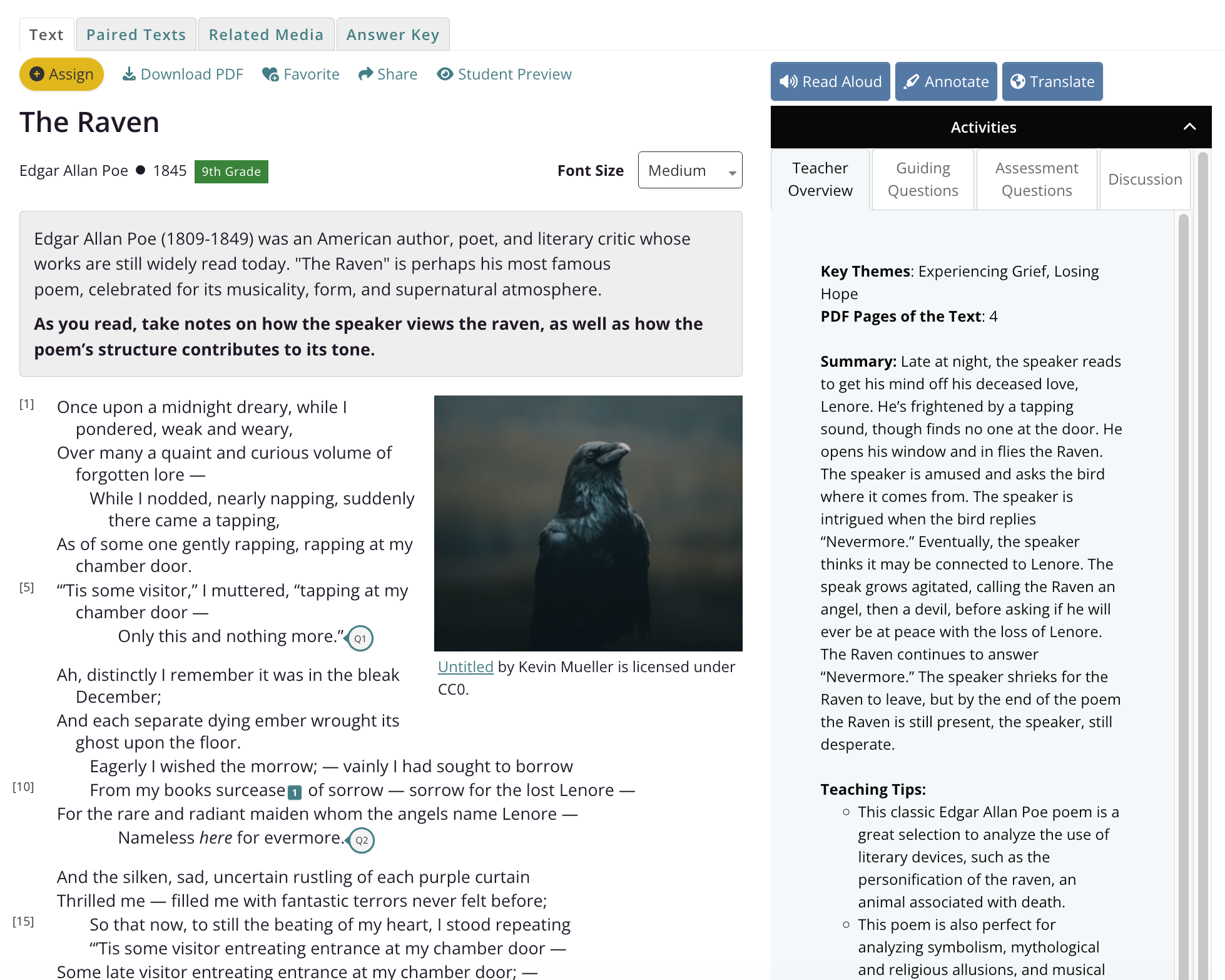
"The Raven" by Edgar Allan Poe (9th Grade)
It's late at night, the speaker is grieving Lenore, and a bird that knows exactly one word has just flown in through the window. Poe's poem works on reluctant readers because it's genuinely spooky.
Use it to teach personification, symbolism, allusion, and the musical devices that make the poem so hard to shake. Try reading a stanza aloud first and asking students what they hear before they analyze anything.
Last Diary Entry of John Wilkes Booth by John Wilkes Booth (9th Grade)
This is a primary source with a chilling voice. Days after shooting President Lincoln, Booth writes that he acted bravely, and he can't understand why the country doesn't see him as a hero.
Keep the tone steady and let the text do the work. Have students separate what Booth claims from what they know happened, then analyze his mindset. It's a strong Civil War source that makes students read closely because they want to push back.
"Is There a Cheater's High?" by Romeo Vitelli, Ph.D. (10th Grade)
Most students have a theory about why people cheat. This text hands them research. It explores whether the joy people feel after acting unethically can push them to do it again, especially when money is involved.
It's a strong pick for tracing how the author's discussion of the Ruedy experiments builds the central idea. It also works well in a lesson on research with human subjects. Expect arguments, and plan to let a few of them run.
Excerpt from Frankenstein: Chapter 10 by Mary Shelley (10th Grade)
Most students know the monster from Halloween costumes. This excerpt gives him a voice. Alone in the mountains, the creature confronts Victor Frankenstein and demands to be heard, while Victor wants nothing more than to be rid of him.
It's a strong pick for showing how a conversation between two characters moves the plot forward, and it fits neatly into a gothic unit. Ask students which character sounds more monstrous in this scene, then ask them to prove it.
"Should We Terraform Mars?" by Paul Scott Anderson (10th Grade)
Making Mars livable sounds like a plan until someone asks what happens if something is already living there. In this opinion piece, Anderson weighs the possibility of native Martian life against the risk of contaminating the planet with bacteria from Earth.
Students already have opinions about space. Use this text to help them separate an author's point of view from the views he describes, then decide whether his reasoning and evidence hold up.
Frequently Asked Questions
Are these texts free?
Yes. Every text in the CommonLit Text Library is free with an educator account—that includes reading questions, assessment questions, answer keys, and paired texts. Go to CommonLit.org, click "Sign Up," choose "I Am an Educator," and confirm your school email.
Can I print these lessons?
Yes. Each text can be downloaded as a PDF or assigned digitally to students.
What grade levels are available?
The CommonLit Text Library includes lessons for grades 3–12, so you can search by grade, theme, or skill. Once you log in to your free educator account, you can browse the 9-12 grade collection to find more texts like these.
Next Steps
All five texts are ready to assign. Create a free CommonLit account to unlock the full library, including guided reading questions, assessment questions, answer keys, and paired texts for every lesson.
