Insights CommonLit 360 Student Reading Growth During the 2024-2025 School Year


A study of the 2024-2025 school year showed that CommonLit usage predicted reading growth
CommonLit conducts an annual study that examines the reading growth of students who took the CommonLit Pre-Assessment and Post-Assessment in a given school year. For the 2024-2025 school year, this study included 277,626 students in Grades 3-12 taught by 5,463 teachers in 1,039 schools in 46 states and Washington D.C. Across all grade bands, students with high CommonLit usage saw significantly higher reading gains compared to students with no usage or low to moderate CommonLit usage. These findings held across schools, regardless of Title I eligibility. This study was reviewed by Instructure Research, an external research team, and validated as meeting ESSA Level 3 (“Promising Evidence”) standards.
About the Study
This study examined the relationship between CommonLit usage and reading growth on the Assessment Series. In the 2024-2025 school year, 277,626 students in Grades 3-12 completed the CommonLit Assessment Series at the beginning and end of the year. These students were taught by 5,463 teachers in 1,039 schools in 46 states and Washington D.C. Based on available NCES data, 43% of the schools in this sample were eligible to receive Title I funding.
Key Finding: CommonLit Usage was Positively Associated with Student Reading Growth Across All Grade Bands
Students’ reading growth on the CommonLit Assessment Series was compared across three groups of students: those with high usage of CommonLit, those with low to moderate usage of CommonLit, and those with no usage of CommonLit. For the middle school grade band (Grades 6-8) and the high school grade band (Grades 9-12), the “high usage” group included those who engaged deeply with the CommonLit 360 curriculum by accessing half or more of the Reading and Writing Lessons in a unit for at least three units. The “low to moderate usage” group included those who accessed some CommonLit lessons, but not to the extent of the high usage group. For the elementary school grade band (Grades 3-5), the “high usage” group included those who accessed at least 36 lessons whereas the “low to moderate” group included those who accessed between 1-35 lessons. Across all grade bands, the “no usage” group included those who did not access any CommonLit lessons.
To test whether these groups of students had meaningfully different levels of reading growth, we conducted statistical models that controlled for students’ baseline scores on the CommonLit Pre-Assessment, their grade levels, and their schools’ Title I eligibility. Across all grade levels, students in the “high usage” group saw the greatest reading growth from the beginning to the end of the year, compared to the “low to moderate” group and the “no usage” group. In other words, the more students used CommonLit, the higher reading growth they tended to see.
High School Grade Band
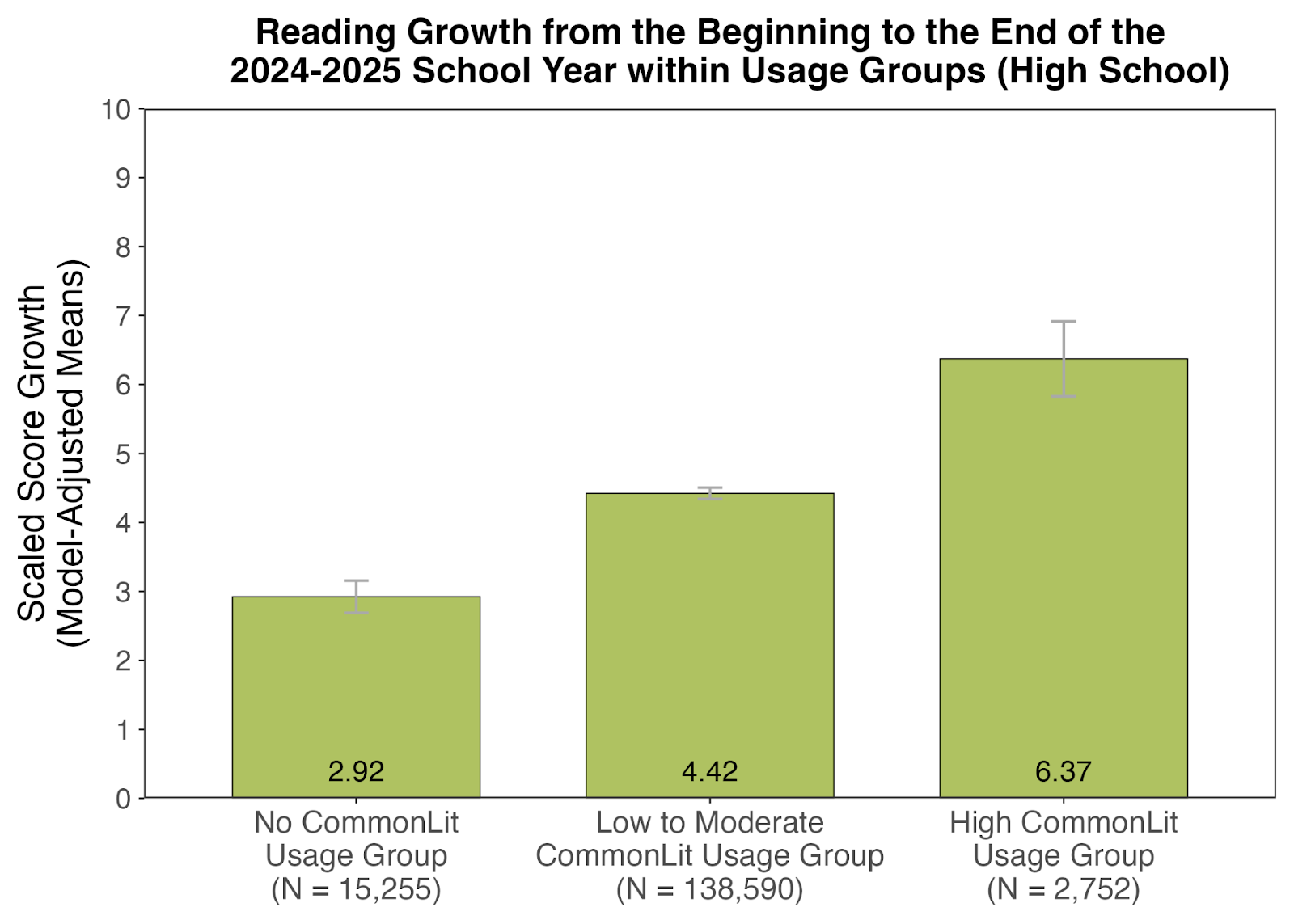
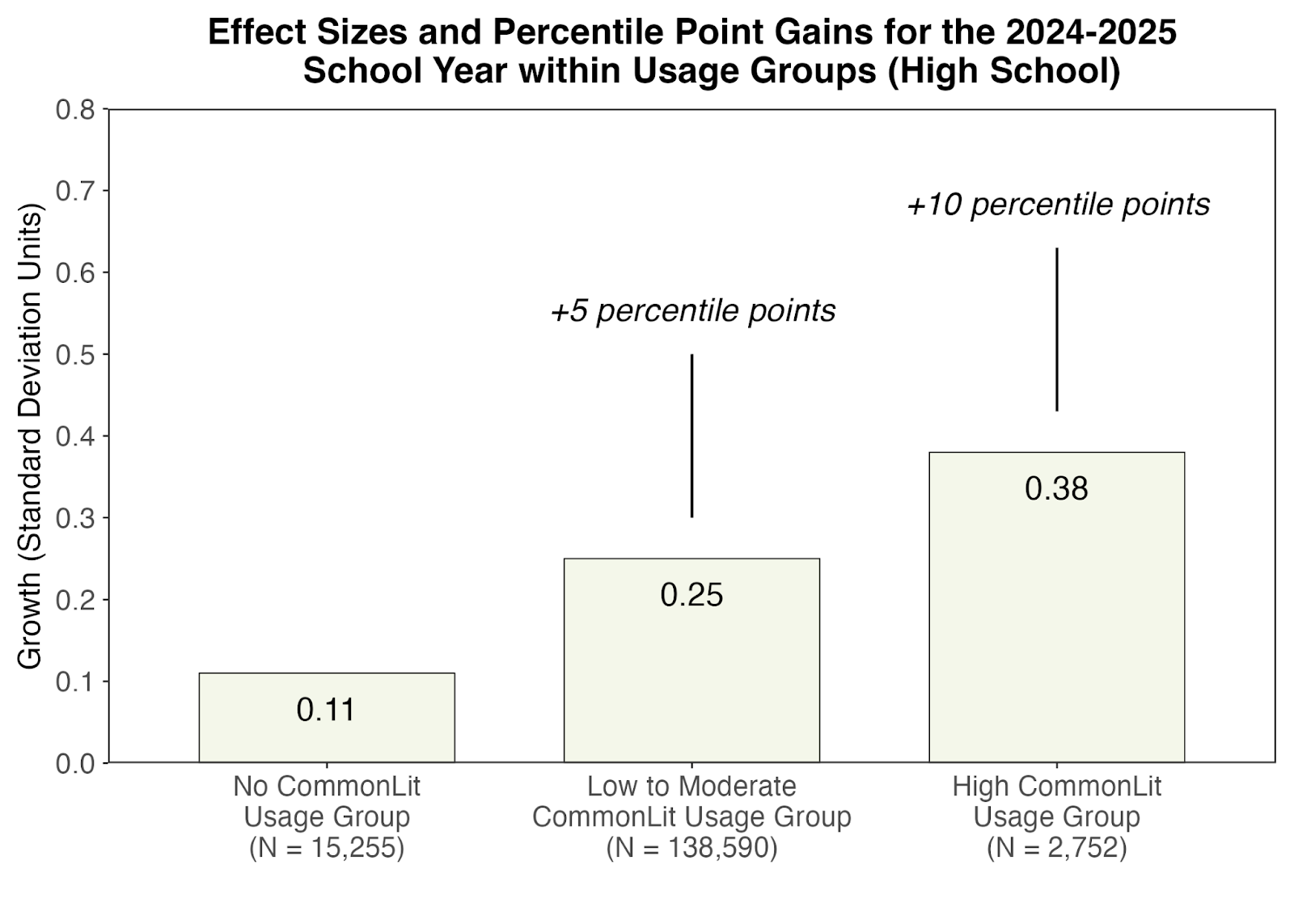
Among high school students in the “high usage” group, the model-adjusted average growth on the CommonLit Assessment Series was 6.37 scaled score points (see Figure 1). The average growth was 4.42 scaled score points for those in the “low to moderate” group and 2.92 scaled score points for those in the “no usage” group who were not using CommonLit. Compared to students in the sample who would score at the median (50th percentile) without using CommonLit, the reading growth observed among those in the high usage group can be translated into a gain of 10 percentile points (from the 50th to the 60th percentile; see Figure 2). Additionally, the reading growth observed among those in the low to moderate group can be translated into 5 percentile point gains (from the 50th to the 55th percentile).
Middle School Grade Band
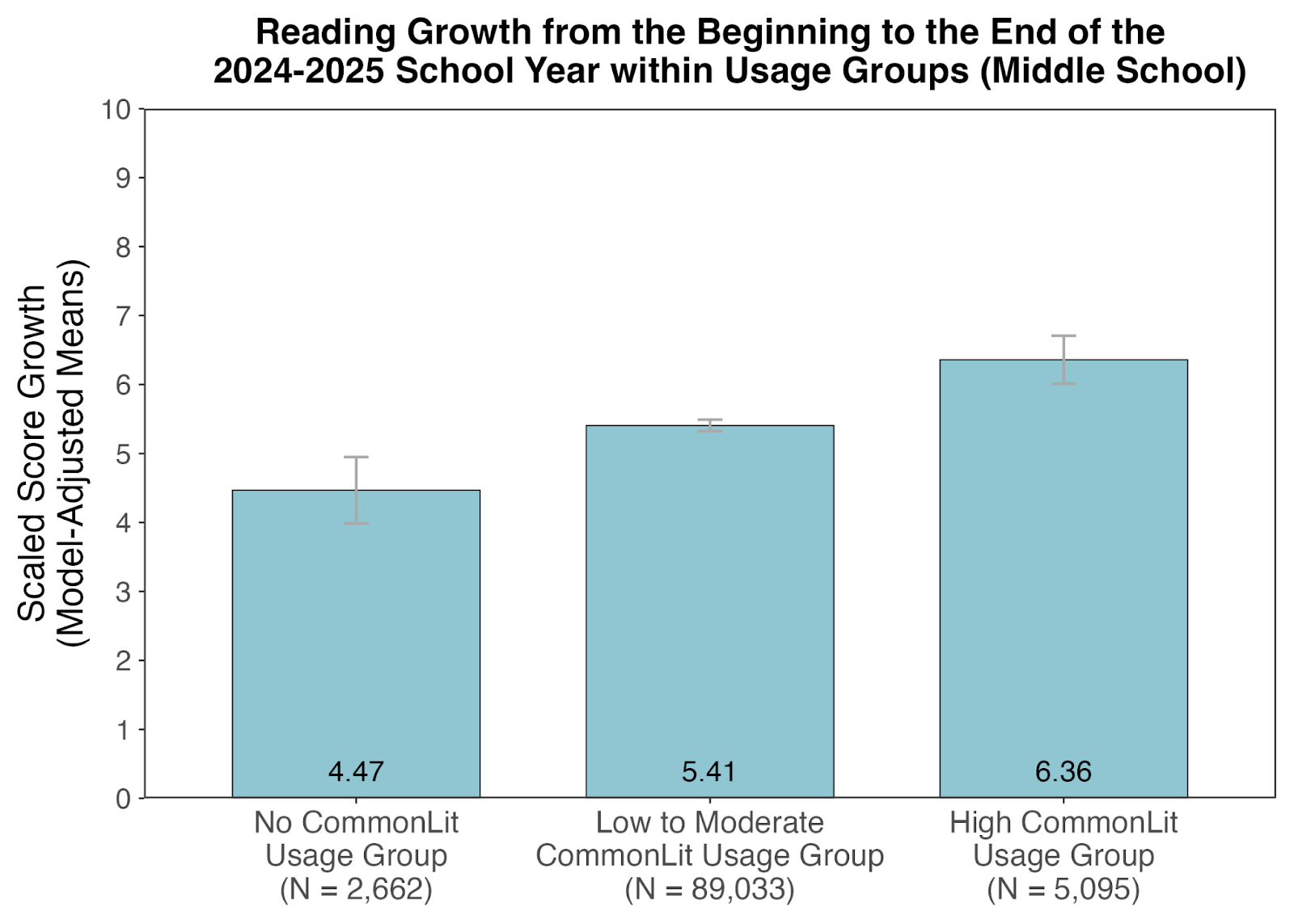
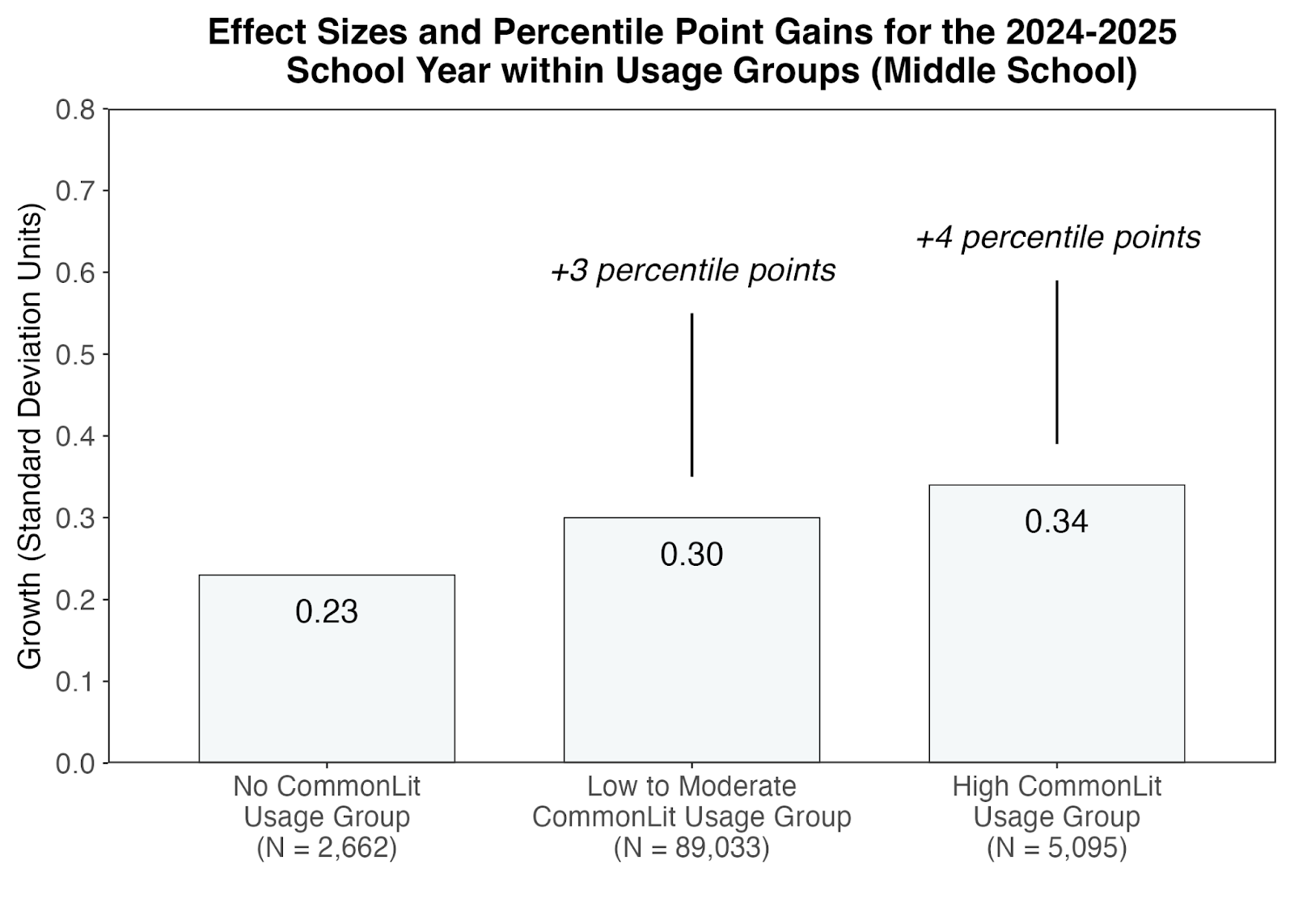
Among middle school students, the model-adjusted average growth on the CommonLit Assessment Series was about 6.36 scaled score points for those in the “high usage” group, 5.41 scaled score points for those in the “low to moderate” group, and 4.47 scaled score points for those in the “no usage” group who were not using CommonLit (see Figure 3). Compared to students in the sample who would score at the median (50th percentile) without using CommonLit, the reading growth observed among those in the high usage group can be translated into a gain of 4 percentile points (from the 50th to the 54th percentile; see Figure 4). The reading growth observed among those in the low to moderate group can also be translated into 3 percentile point gains (from the 50th to the 53th percentile).
Elementary School Grade Band
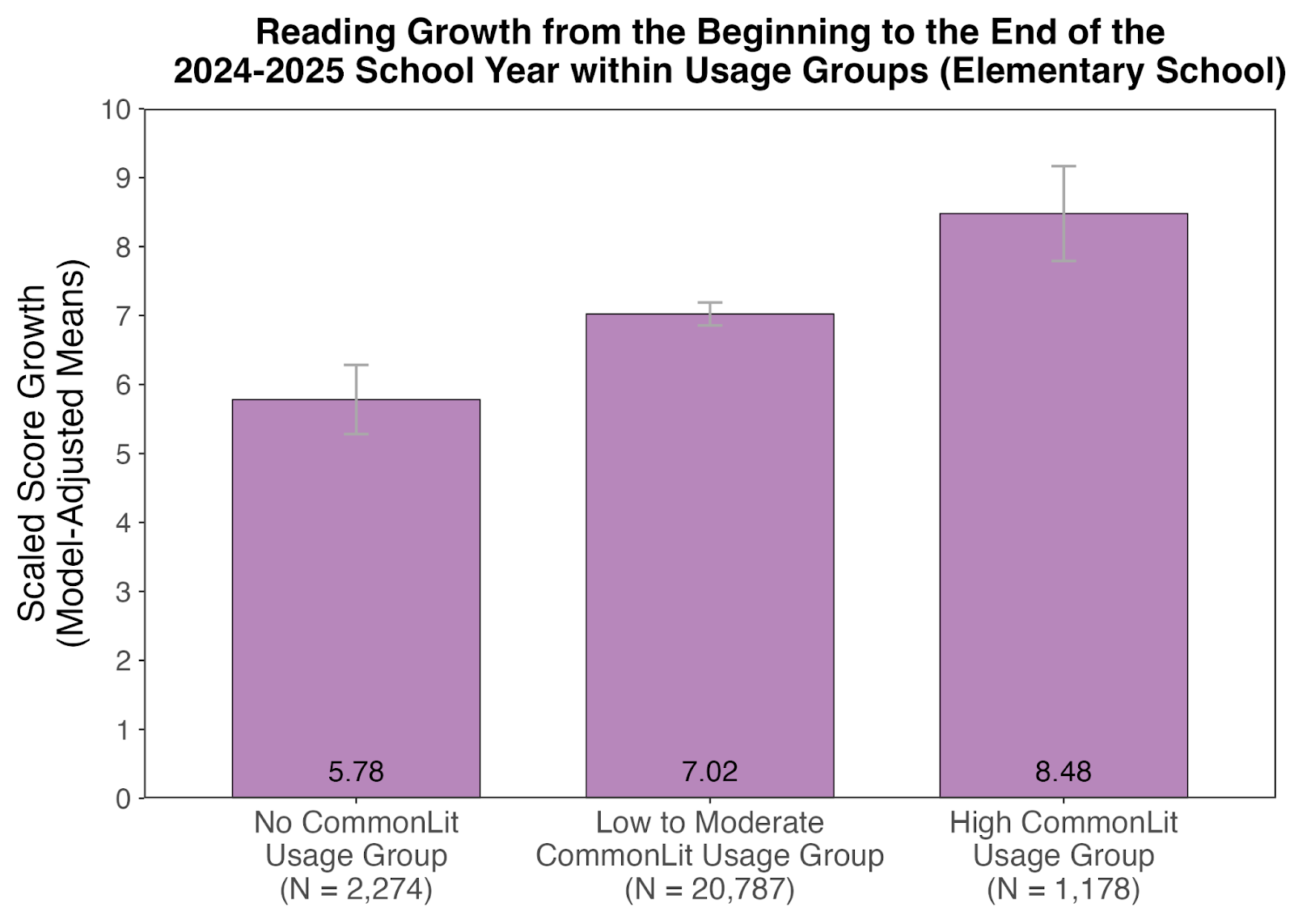
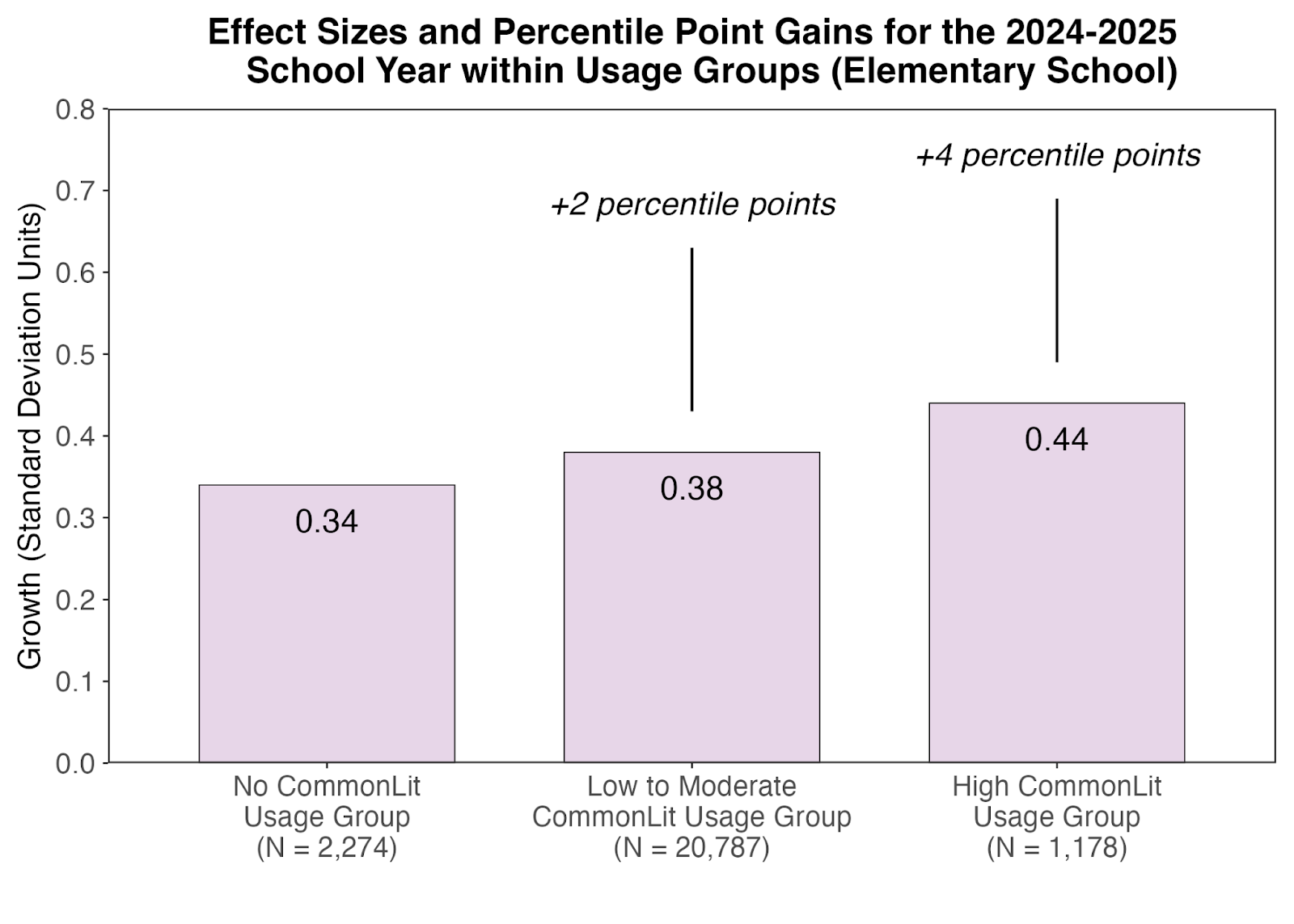
Finally, among elementary school students, the model-adjusted average growth on the CommonLit Assessment Series was 8.48 scaled score points for those in the “high usage” group, 7.02 scaled score points for those in the “low to moderate” group and 5.78 scaled score points for those in the “no usage” group who were not using CommonLit (see Figure 5). Compared to students in the sample who would score at the median (50th percentile) without using CommonLit, the reading growth observed among those in the high usage group can be translated into a gain of 4 percentile points (from the 50th to the 54th percentile; see Figure 6). Additionally, the reading growth observed among those in the low to moderate group can be translated into 2 percentile point gains (from the 50th to the 52nd percentile).
In sum, across all grade bands, CommonLit usage was positively associated with students’ reading growth on the CommonLit Assessment Series. This relationship was significant even when accounting for important factors such as baseline scores on the Pre-Assessment, grade levels, and schools’ Title I eligibility status. Students who engaged deeply with CommonLit saw significantly higher reading growth compared to students with lower or no CommonLit usage. For more information about the study, check out the technical research report here.
Get These Results in Your District
Want to see these results in action? Connect with our team to learn how CommonLit 360 can support your school.
