Insights Positive Relationship between CommonLit Usage and State ELA Scores in Maryland

At Harford County Public Schools, students’ state ELA test scores were associated with their CommonLit usage.
Harford County Public Schools (HCPS) in Maryland entered a research partnership with CommonLit to learn more about the relationship between CommonLit’s materials and their students’ ELA performance. A study of the 2023-2024 school year provided several insights for leaders at Harford. First, students' scores on the CommonLit Assessment Series were positively correlated with their scores on the Maryland Comprehensive Assessment Program (MCAP), suggesting that the Assessment Series can be a useful resource in high-stakes state test preparation for HCPS students. Second, students who scored “On Grade Level” or “Above Grade Level” on the CommonLit Post-Assessment were highly likely to score “Level 3 - Proficient Learner” or “Level 4 - Distinguished Learner” on the MCAP, indicating high correspondence for these performance levels across tests. Finally, students with more CommonLit lessons performed significantly better on the MCAP compared to students with fewer CommonLit lessons. The ELA achievement observed among students with more CommonLit lessons can be translated into gains of 5 percentile points. In sum, through a research partnership between CommonLit and HCPS, this study provided support for the efficacy of CommonLit for HCPS students' ELA achievement. The Instructure Research Team reviewed this study and validated it to meet ESSA Tier 3 (“Promising Evidence”) standards.
About the Sample
The study sample included students who took both the CommonLit Assessment Series and the MCAP in the 2023-2024 school year. Overall, there were 4,985 students in Grades 3-8 and 10 taught by 166 teachers across 34 schools in Harford County. All schools had access to the resources available in CommonLit’s School Essentials Pro package. Based on National Center for Education Statistics (NCES) data, 13 schools (38%) were eligible for Title I funding in the 2023-2024 school year. Student-level demographics were provided by HCPS. The analysis sample included 51% male students and 49% female students. In terms of race and ethnicity, the sample included 60% White students, 20% Black students, 10% multiracial students, 7% Hispanic/Latino students, and 4% Asian students. Three percent of the sample qualified for English Language support according to the WIDA Access assessment. Eleven percent of the sample had an IEP (Individualized Education Program) and received special education services. Seventeen percent of the sample were identified as gifted and talented by HCPS’ screening process.
Key Finding #1: Students’ scores on the MCAP ELA test were positively correlated with their scores on the CommonLit Assessment Series
This study first examined the relationship between students scores’ on the CommonLit Assessment Series (Pre-Assessment and Post-Assessment) and the MCAP (ELA scaled scores and reading-only scaled scores). Table 1 shows the correlations between the assessments. All correlations were positive and ranged from r = .72 to r = .75. For moderate-stakes decisions, such as using assessment data to differentiate instructional time, guidelines from Truckenmiller and colleagues (2024) have stated that correlations with state tests should be positive and above r = .60. These findings provided support for the relationship between the CommonLit Assessment Series and the state ELA test in Maryland. These findings were also consistent with previous studies that have documented positive relationships between the CommonLit Assessment Series and state ELA tests in New York, Florida, and New Jersey.
Table 1. Correlations between the MCAP and the CommonLit Assessment Series (N = 4,985)
Key Finding #2: Students who were proficient on the CommonLit Assessment Series were highly likely to be proficient on the MCAP ELA test
To build on Key Finding #1, this study examined the correspondence between performance levels on the MCAP and the CommonLit Post-Assessment. For the analysis, Levels 1 and 2 on the MCAP were considered to be “Below Proficient” and Levels 3 and 4 on the MCAP were considered to be “Proficient.” Likewise, the “Below or Approaching Grade Level” category on the CommonLit Post-Assessment was considered to be “Below Proficient” and the “On Grade Level” and “Above Grade Level” categories were considered to be “Proficient” (see Table 2).
Table 2. Performance Levels for the MCAP and CommonLit Assessment Series.
Results showed that students who were classified as proficient on the Post-Assessment were 94% likely to be classified as proficient on the MCAP. This suggested that the performance classifications of “On Grade Level” and “Above Grade Level” on the Post-Assessment were a close reflection of how well students may perform on the MCAP. Results also showed that students who were classified as below proficient on the Post-Assessment were only 54% likely to be classified as below proficient on the MCAP. In other words, those who scored below proficient on the Post-Assessment did not necessarily score below proficient on the MCAP. This may be possible if students received targeted instruction ahead of the MCAP, or if students took the MCAP more seriously as a higher-stakes state test. Overall, these results showed strong correspondence between the proficient levels across the CommonLit Post-Assessment and the MCAP.
Key Finding #3: Students’ CommonLit usage significantly predicted their performance on the MCAP ELA test
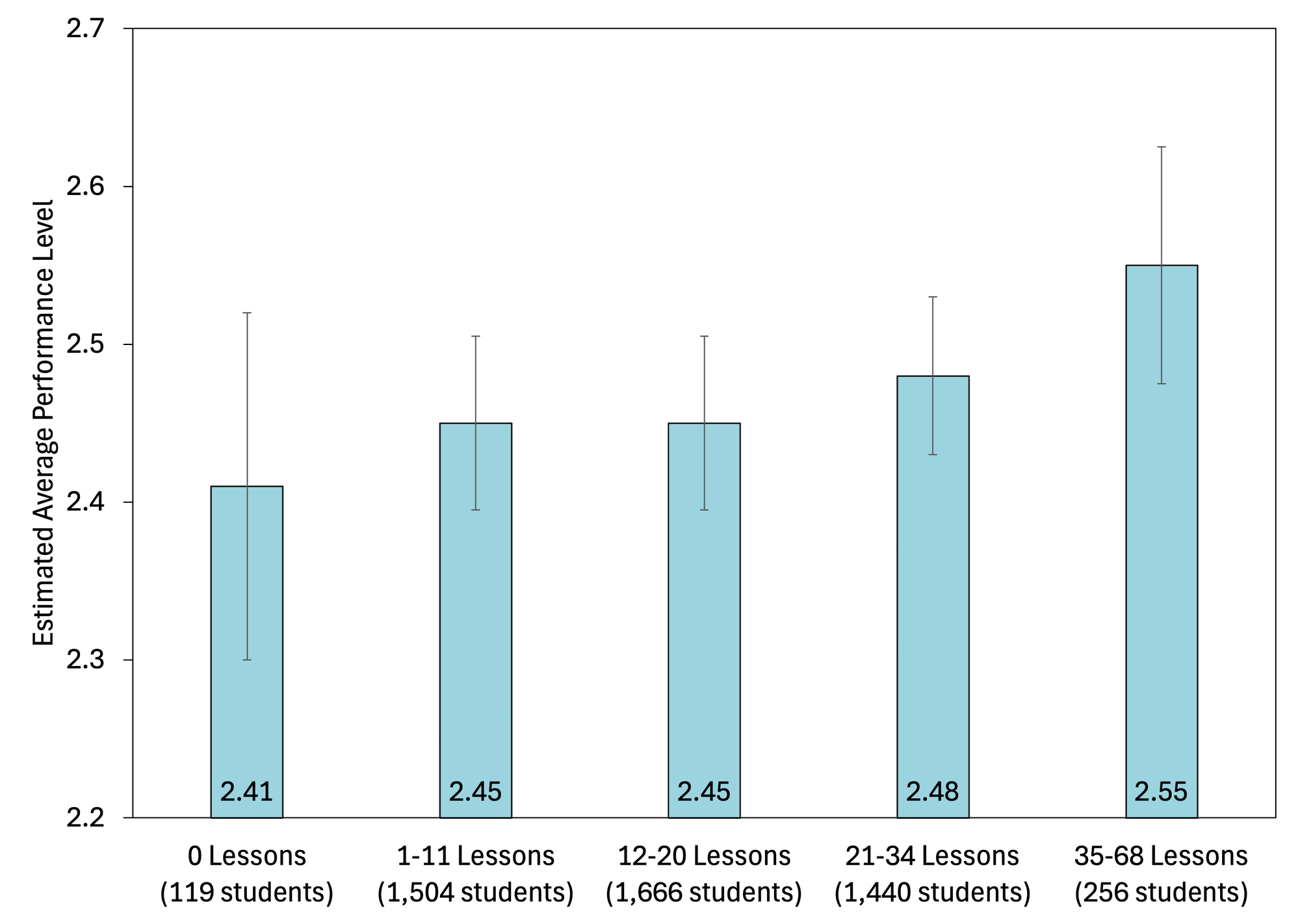
The study also examined whether there was a positive relationship between students’ usage of CommonLit and their performance on the MCAP ELA test. Indeed, results showed that this relationship was both positive and statistically significant. Importantly, the analysis controlled for factors that may influence this relationship, such as students’ baseline scores on the CommonLit Pre-Assessment, as well as student demographics. Figure 1 shows the estimated average performance levels for each usage group. Students with 35-68 lessons performed significantly better on the MCAP than students with 20 or fewer lessons. The ELA achievement observed among this sample of students can be translated into 5 percentile point gains, relative to students who would score at the median with lower levels of CommonLit usage.
For more information about the study, see the technical report.
CommonLit is evidence-based
Studies like this one that show exciting gains for students in CommonLit classrooms contribute to our growing evidence base of research and showcase the effectiveness of CommonLit. To ensure that CommonLit’s programs are aligned with the mission to close the literacy achievement gap, both external evaluators and researchers on CommonLit’s evaluation team are constantly monitoring student outcomes. CommonLit’s evidence-based approach directly supports districts by giving them confidence in our programs and by earning ESSA tier certifications.
About CommonLit
CommonLit offers several educational resources for teachers and schools. CommonLit 360 is CommonLit’s free English Language Arts program that includes a year-long curriculum, assessments, professional development, and data dashboards. Ed Reports recently rated CommonLit 360 as all-green, or “meets expectations”, as a quality curriculum. CommonLit also offers a Text Library that includes a wide variety of standards-aligned texts as well as supplemental lessons and Target Lessons designed to support the learning needs of all students. To address inequities in access to technology in classrooms, CommonLit materials are available to teachers and students both online on the digital platform and offline as downloads.
Get These Results in Your District
Find out how you can see the same growth with CommonLit in your school or district today.
