CommonLit 360 CommonLit 360 Foundations: Learning Together through Peer Feedback, Partner Work, and Presentation Prep


Here at CommonLit, we have four Guiding Principles that represent our foundational beliefs about teaching and learning. Our curriculum team—all experienced former educators—have carefully developed CommonLit 360 to align with these guiding principles and ensure that each unit and lesson is designed to support the growth and success of all learners.
In this blog series, we have invited members of CommonLit’s curriculum team to share a bit more about the practices that support the design of our curriculum. This article is connected to Guiding Principle 4: Learning is Fundamentally Social. We believe that learning is an inherently social process where students acquire knowledge and skills through interaction, collaboration and observation. Learn more about our Guiding Principles in our CommonLit 360 Program Guide!
At CommonLit, one of our most energizing guiding principles is the belief that learning is fundamentally social. Students don’t just learn from books and teachers – they learn from each other. That’s why CommonLit 360 is designed to give students frequent, structured opportunities to collaborate, share ideas, and build their skills together.
To explore how this comes to life in Culminating Tasks, we spoke with Noel Quivey, CommonLit’s Associate Director of Curriculum. Quivey reflected on what makes these tasks so powerful – and how they prepare students not just for tests, but for college, careers, and the real world.
From Teacher to Curriculum Designer: Why Social Learning Matters
Looking back on her own 12 years in the classroom, Quivey shared that making learning truly collaborative took time and intentional practice. “It took a lot of coaching, it took a lot of confidence. It took a lot of looking at other classrooms to get there. Once I started teaching with strategic groups – sometimes in fours, sometimes in twos – the engagement went way up. Students loved working with their peer groups. But there’s a lot of pre-work that goes into creating a classroom where kids are talking, on-task, and learning from each other. Even 12 years in, I was still working on it. It was never perfect, but it was something I was working on every, every year,” shared Quivey.
Building a classroom environment that prioritizes social learning can be a tricky thing to master, even for veteran teachers. Leaning into this guiding principle can feel great in theory, but scary in practice. So why do it?
Social learning doesn’t mean letting go of rigor or control; it means building routines and structures that help students thrive together. Striking a balance between structure and collaboration is how CommonLit 360 achieves Guiding Principle 4, and this shines brightest when students are working on their Culminating Tasks.
What Are Culminating Tasks?
Culminating tasks are the summative assessments at the end of each CommonLit 360 unit – the projects, essays, or presentations that synthesize everything students have learned. In Edition 1.0 of CommonLit 360, these were often essays. In Edition 2.0, the menu has expanded.
“We know that speaking and listening skills are equally important as reading and writing,” Quivey explained. “If you think about things that kids need to do either in college or in their careers, speaking and listening is a huge part of it. Presenting research, persuading someone, or creating multimedia or a graph to demonstrate what it is you’re trying to communicate, this is all just as critical as essay writing. We wanted every format to have its moment in the sun.”
That’s why you’ll see culminating tasks that include more opportunities for peer feedback, partner work, and presentations, alongside more traditional essays.
Ensuring Engagement and Authenticity
A hallmark of 360’s culminating tasks is that they yield diverse, authentic responses.
“We want prompts that don’t produce 30 identical essays or presentations,” Quivey said. “Students infuse their own choices – what to say, how to say it, and what medium to use. That variety is what makes the classroom feel alive.”
For example, in 10th Grade Unit 4 Ed2.0, Voting Rights: Then and Now, students choose how to inform peers about a complex process. Some may design timelines, others graphs, others videos. The result: students take ownership of both the content and the format.
Partner Work: Collaboration with Purpose
Throughout CommonLit 360 units, students collaborate in partners or small groups to generate ideas, plan tasks, and practice skills. This isn’t unstructured chatter – it’s deliberate collaboration built into the unit design.
These collaborative routines help students challenge each other’s thinking, build accountability, and learn how to negotiate meaning together.
Peer Feedback: Dialogue that Drives Growth
Peer review isn’t just about saving teachers time – it’s about students receiving authentic feedback from an audience that matters most: their classmates.
“A teacher can’t give 30 pieces of feedback at once,” Quivey said. “Peers can often catch gaps or needs that a teacher might not always have the capacity to catch. And kids are motivated to work together. When class culture is established, peer review is super effective.”
In practice, this means students build confidence and critical thinking skills by analyzing each other’s work, reflecting on peer ideas, and revising in response to authentic feedback. Culminating tasks become stronger and more authentic because of the feedback that they have received from peers.
Presentations: Speaking and Listening as Rigorous Practice
One of the biggest shifts in CommonLit 360’s Edition 2.0 is the inclusion of presentations as the Culminating Task. In Edition 2.0 units like 9th Grade Unit 3 (Speak Up, Speak Out: Speech and Rhetoric) and 10th Grade Unit 2 (Fahrenheit 451), students don’t just analyze texts - they craft and deliver original speeches or presentations to their peers.
“Standing up and presenting to your classmates is rigorous,” Quivey noted. “In fact, many professionals would rather write an essay than give a presentation. But in the real world, presenting your ideas clearly and persuasively is essential.”
To make this doable, the curriculum includes scaffolded lessons on building visuals, practicing delivery, and listening as an audience member; many of which incorporate opportunities for peer feedback and collaboration.
Final Thoughts: Structured, Social, and Student-Centered
Successful completion of the Culminating tasks in CommonLit 360 Edition 2.0 embodies the principle that learning is fundamentally social. With intentional scaffolds, authentic audiences, and opportunities for discussion, they prepare students to not only master ELA standards but to succeed in real-world contexts. But students aren’t the only ones who CommonLit aims to set up for success.
As Quivey put it: “We really want to make sure that facilitation and pacing aren’t reasons not to do some of these beautiful culminating tasks.”
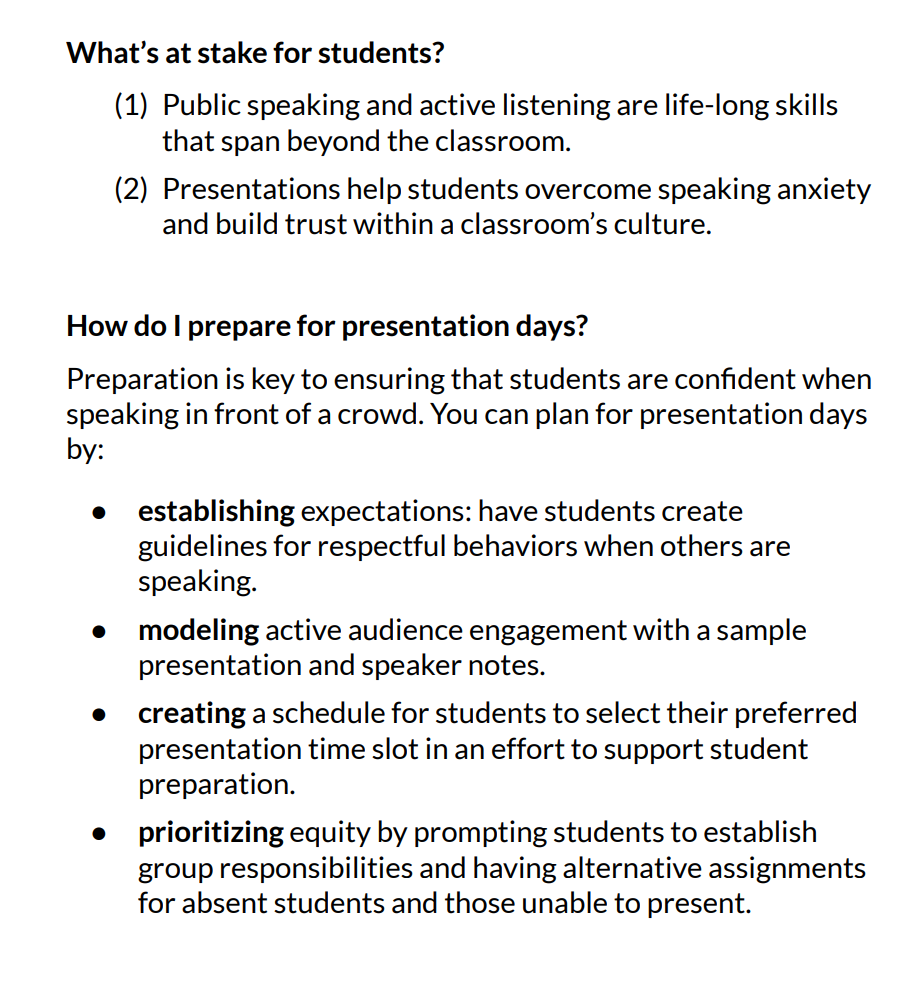
The pacing of each unit takes into consideration the additional time needed for students to prepare and present speeches and presentations. Teachers can also access Instructional Strategies for each unit, free resources that provide teachers research-based tips to get the most out of CommonLit 360 lessons. Below is an excerpt from our Instructional Strategies resource for Facilitating a Student Presentation:
When classrooms embrace peer feedback, partner work, and presentations, students aren’t just learning in isolation – they’re practicing the art of learning together.
Ready to See CommonLit in Action?
Teachers: We know learning is fundamentally social, that's why we've taken time to weave in moments of social learning throughout units, particularly writing lessons that lead to the culminating task. Lean into the benefits of structured peer learning the next time you engage students in a unit's culminating task and let your students' social skills shine.
Administrators: When observing 360 classrooms, look for purposeful collaboration: peers reviewing each other’s work, students practicing presentations in small groups, or authentic discussions that build conceptual understanding.
Curious to learn more? Explore CommonLit 360 or reach out to our team – we’d love to show you how this social approach to learning can transform your classrooms.
