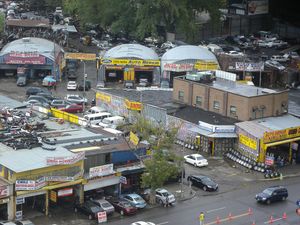
In "How the Immigrant Dream Died in an Automotive Shantytown," reporters Corey Kilgannon and Andrea Salcedo document the experiences of some of Willets Point's largely-immigrant business owners and residents during their fight to preserve both their community and their livelihoods in a vanishing version of New York City.
Pair “Every Man a King” with “How the Immigrant Dream Died in an Automotive Shantytown” and ask students to apply Huey P. Long’s views on wealth inequality to the experience of the Willets Point business owners and residents. In “Every Man a King,” how does Long use the Declaration of Independence to argue against societal acceptance of wealth inequality? Explain Long’s key arguments in favor of wealth distribution, and how he uses multiple types of historical writing and cultural reference points to support those arguments. According to both texts, what is the relationship between wealth inequality and gentrification? How does this connect with what the Willets Point workers are experiencing? What are the key features of Long’s proposed “Share Our Wealth Society”? Would any of the initiatives mentioned in the Long’s radio broadcast help the people of Willets Point? Why, or why not? What might Huey P. Long say about the gentrification of Willets Point and the displacement of its businesses and residents? Have students support their response with evidence from both texts.