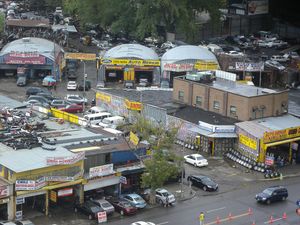
In "How the Immigrant Dream Died in an Automotive Shantytown," reporters Corey Kilgannon and Andrea Salcedo document the experiences of some of Willets Point's largely-immigrant business owners and residents during their fight to preserve both their community and their livelihoods in a vanishing version of New York City.
Pair “Fear of Change” with “How the Immigrant Dream Died in an Automotive Shantytown” and ask students to consider the degree to which Ford’s argument about fear of change holds true today. According to Ford in “Fear of Change,” who should — and shouldn’t — fear change, and why? According to Ford, how are the “privileged aristocracy” in the United States no different from the old monarchs of Europe? What are the two evils of the world, according to Ford, and how can they be eradicated? In paragraphs 54-55, Ford says:
“Nothing will ever happen that will dethrone the worker. He is the one class who place is secure throughout all time. The man who produces by his thought or his labor will always be in request and in favor. He constitutes the continuing class—he is the hold-over through every change.
That is why the workers are not afraid.”
Do students think that Willets Point residents would agree with Ford’s argument? Do students agree with Ford’s argument about the security of workers? What might Henry Ford say to the people of the Willets Point community who face losing their businesses and livelihoods? Why?