CommonLit 360 CommonLit 360 in 9th Grade: Civic Responsibility and Our Role in Society

Explore what a year looks like in a 9th grade CommonLit 360 classroom
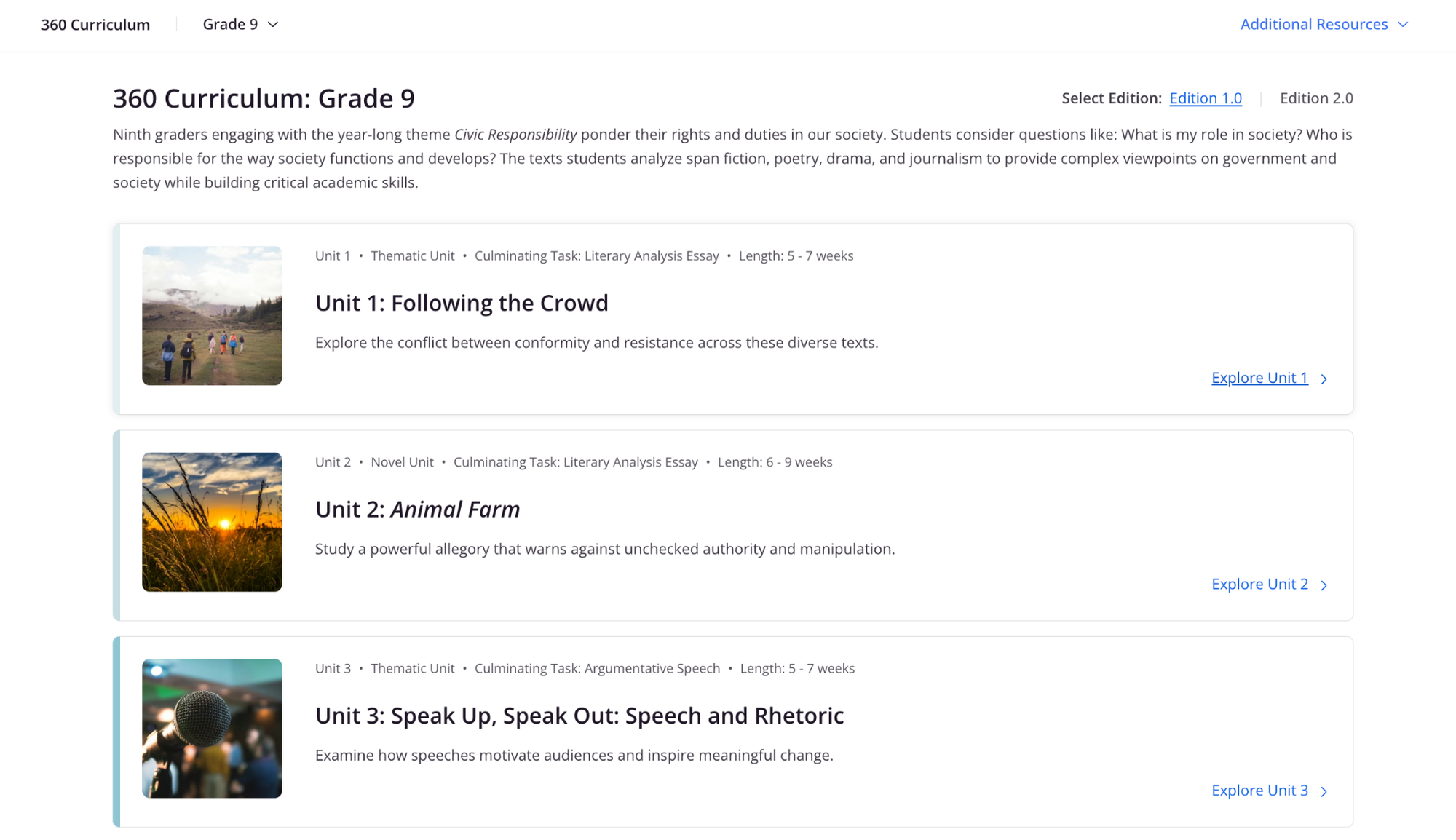
Ninth graders engaging with the year-long theme of Civic Responsibility ponder their rights and duties in our society. Students consider questions like: What is my role in society? and Who is responsible for the way society functions and develops? The texts students analyze span fiction, poetry, drama, and journalism to provide complex viewpoints on government and society while building critical academic skills. Throughout the year, students will read texts from renowned authors, like George Orwell, Abraham Lincoln, and Shirley Jackson.
CommonLit 360 is designed as a full-year secondary English Language Arts curriculum, created with adolescents in mind. It is built to help teachers feel confident that they are covering skills across all domains of ELA—reading, writing, speaking and listening—through grade-level units, meaningful culminating tasks, and lessons that intentionally build toward those outcomes. The curriculum uses a backwards planning approach, beginning with essential questions, thoughtful text selection, and rigorous culminating tasks so that instruction remains coherent and purposeful throughout the year.
What makes 9th grade CommonLit 360 stand out
In 9th grade, CommonLit 360 invites students to think deeply about civic responsibility, power, justice, and the role individuals play in society. Through short stories, novels, speeches, journalism, and drama, students analyze how people respond to influence, corruption, duty, and public expression. Teachers benefit from a curriculum that is intentionally sequenced and designed to build students’ reading, writing, speaking, and critical thinking skills across the year.
You can check out the full Scope and Sequence for CommonLit 360. Below is a look at the six units that shape the year for 9th grade.
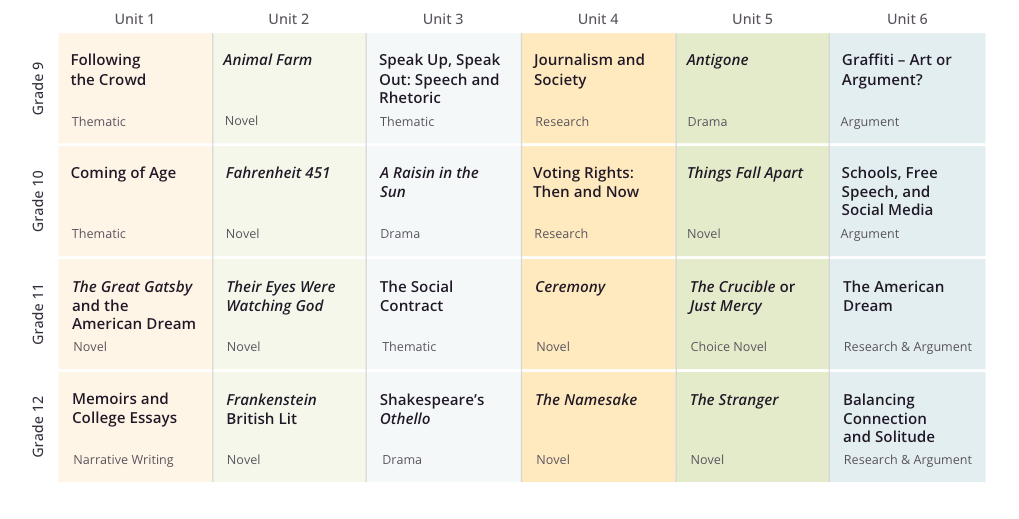
Unit 1: Following the Crowd
In this unit, students read engaging short stories that evaluate how being in a group affects human behavior and explore real-world examples of the risks and benefits of following the crowd. Students read about relatable characters who face the decision to either follow the crowd or stand up and act as an individual, and they collaborate with peers to discuss what conformity looks like in everyday life. At the end of the unit, students compare and contrast the motivations of two characters from the unit’s texts who made choices based on social influence.
Unit 2: Animal Farm
Students engage in a study of George Orwell’s allegorical novel Animal Farm to draw connections between historical and literary events and the world in which they live. By the end of the unit, students are able to identify and analyze the themes of the novel, understand how word choice impacts meaning in a work of literature, and engage in a Socratic seminar about a classic text. The unit includes chapter guides that help students track the plot of the story as they read.
Unit 3: Speak Up, Speak Out — Speech and Rhetoric
As they move through this thematic unit, students learn how public speaking and the strategic use of rhetoric can spark civic engagement and drive social change. By analyzing influential historical and contemporary speeches, they examine how rhetorical techniques and delivery choices shape the audience’s response. Students deepen their understanding of these strategies by applying them to their own writing and discussions. To demonstrate their learning, students draft and deliver a compelling speech advocating for positive change in their school or community.
Unit 4: Investigative Journalism
In this unit, students learn about the importance of investigative journalism by analyzing how it brings attention to critical issues and drives change. They explore historic and modern examples of investigative reporting and learn about the ethical concerns that guide it. Students also develop their understanding of media literacy by comparing how multiple sources report on the same news story and learn how to recognize misinformation. For their Culminating Task, students conduct independent research on an impactful case of investigative journalism and create a multimedia presentation to share their learning with their peers.
Unit 5: Antigone
Students step into ancient Greece as they read the classic play Antigone, exploring what happens when personal beliefs conflict with one’s civic duty. They consider how laws, values, and justice shape people’s choices and consequences. Through related poems and media, students examine how Antigone’s story connects to modern ideas about standing up for what’s right. For their final project, students independently research a real-world example of civil disobedience and argue whether it’s worth the risk.
Unit 6: Graffiti — Art or Crime?
In this unit, students examine the role of graffiti in communities, considering both its value as a form of artistic expression and its potentially negative effects. Through articles, videos, and a choice board of artist profiles, they explore why opinions about graffiti often differ. Students practice defending their ideas with evidence in a lively debate as they prepare for the Culminating Task, in which they craft an argumentative essay that clearly identifies and supports their position on whether the benefits of graffiti outweigh its harms.
Ninth grade is an important year as students begin high school and take on more complex texts, ideas, and discussions. With CommonLit 360, students engage with reading, writing, speaking, and thinking that feels purposeful, relevant, and appropriately challenging.
Curious about what other grade-level scope & sequences include? Check out our other CommonLit 360 Overview Blogs: 6th Grade, 7th Grade, 8th Grade, 10th Grade, 11th Grade, & 12th Grade.
Using CommonLit 360 as your shared curriculum
Our goal at CommonLit isn’t just to provide great unit materials. It’s to ensure schools have the structure, insight, and support needed to make those materials truly work for students.
That’s where School Essentials PRO Plus—and our team of CommonLit 360 experts—come in.
School Essentials PRO Plus supports the school and district-level rollout of the CommonLit 360 curriculum with the additional assessments, professional learning, and ongoing support.
What comes with School Essentials PRO Plus?
Professional Development
Through curriculum-based learning experiences, CommonLit Professional Development enhances teachers’ skills, knowledge and confidence to meet their students’ needs. Includes:
- Up to four 45-60 minute virtual professional development sessions for your team
- Unlimited access to CommonLit’s professional development webinars, exclusively for schools and districts with School Essentials PRO Plus
- Access to unit-specific internalization modules and planning resources for every unit in CommonLit 360
- Access to dozens of self-paced modules via CommonLit’s Professional Development Portal
- Option to purchase On-Site Professional Development
CommonLit 360 Curriculum Implementation Support
A CommonLit partnership includes a dedicated CommonLit account manager who provides:
- A kickoff meeting and mid-year curriculum implementation check-in with CommonLit experts
- Live facilitation of leader trainings (titled Building Your CommonLit 360 Leader Toolkit sessions)
- Ongoing support from CommonLit 360 experts to ensure your school’s implementation of CommonLit 360 is a success
Data & Assessments
This package includes Unit Skills Assessments for CommonLit 360, which provide teachers with additional insight into student learning throughout each unit. There are two assessments per unit, and they measure students’ comprehension of cold-read texts while helping teachers monitor progress toward grade-level skills.
Integrations
CommonLit 360 seamlessly fits into a school’s toolkit by integrating directly with Google Classroom, Clever, Canvas, and ClassLink.
